Opportunity AI: How Leaders Turn AI Into New Revenue, Not Just Savings
Most companies I meet use AI to do the same work faster. Fewer hours. Lower costs. Tidier processes.
That matters. But it is the smaller prize.
The bigger prize is new revenue. New products. New partners. New markets. I call this Opportunity AI, and it is the theme I get asked about most as an AI keynote speaker in 2026.
Having reviewed more than 1,000 real-world AI projects through the AI Awards, and delivered over 300 keynotes for clients including Microsoft, Oracle, Salesforce and PwC, I see the same pattern everywhere. The companies winning with AI are not just saving money. They are making money they could not make before.
In this post I explain the difference between Efficiency AI and Opportunity AI, share six real examples of AI creating new revenue, and give you three steps to find your own opportunity.
Efficiency AI vs Opportunity AI
Think of AI like electricity in a factory a century ago. The first factories used it to run the old machines faster. The winners redesigned the factory around it.
| Efficiency AI | Opportunity AI |
| Question it answers | “How do we do this cheaper?” | “What can we now sell?” |
| Result | Lower costs | New revenue |
| Ceiling | 100% of current costs | No ceiling |
Efficiency AI has a hard limit. You can only cut costs to zero. Opportunity AI has no limit, because new markets and new products keep opening.
The research backs this up. McKinsey’s [State of AI survey]found that 80% of companies set efficiency as the goal of their AI work, but the companies seeing the most value are the ones that also set growth and innovation as objectives. The same firm estimates generative AI could add $2.6 to $4.4 trillion annually to the global economy, and that figure does not even count entirely new product categories.
Here is the key point for business leaders: your competitors are all doing Efficiency AI. It is table stakes. Opportunity AI is where you pull ahead.
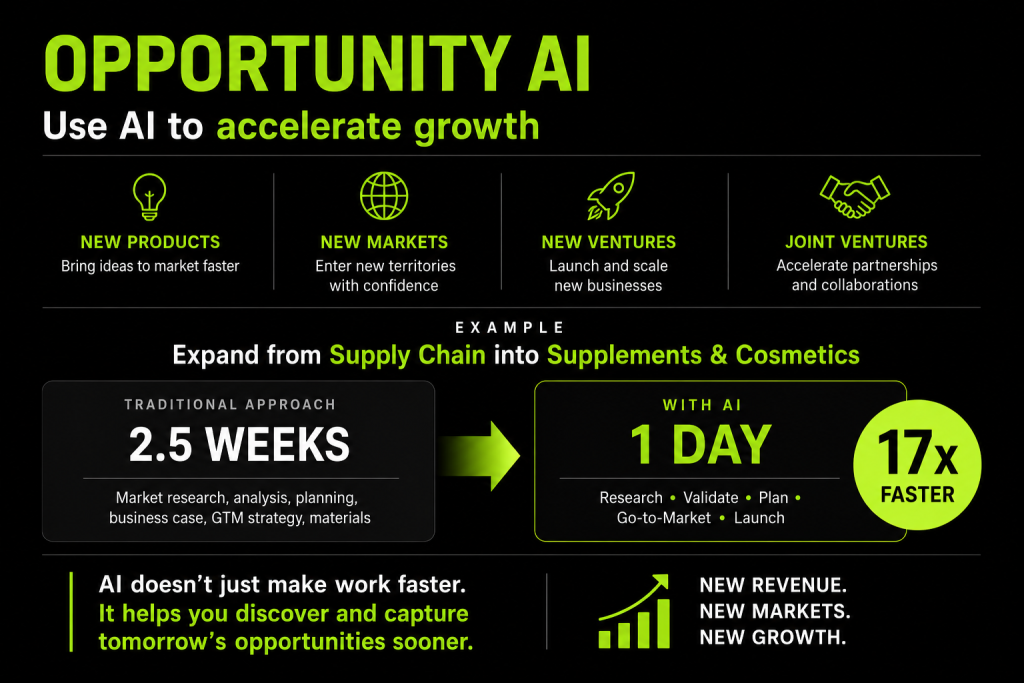
Opportunity AI focuses on using AI to create growth opportunities by launching new products, entering new markets, building new ventures and accelerating go-to-market strategies.
Six Real Examples of Opportunity AI
These are the kinds of stories I share on stage, drawn from patterns across the 1,000+ projects I have reviewed. Names are withheld, but the moves are real.
1. A medical device supply chain firm launches a supplements line
A company managing supply chains for medical devices used AI to analyse years of ordering data from pharmacies and clinics.
The analysis showed something nobody had spotted. Their customers were buying wellness supplements from other suppliers, in volumes that matched patterns the firm already understood.
They had the logistics. They had the regulatory know-how. They had the customer relationships. AI simply revealed the gap.
They launched a supplements line through their existing channels. Same trucks, same customers, new revenue stream.
Why it matters: your proprietary data often contains a product you have not built yet.
2. A joint venture neither partner could see alone
Two mid-sized firms served the same industry from different angles. One had deep engineering capability. The other had distribution and customer trust.
An AI-driven market analysis mapped capability gaps against unmet demand in their sector. It showed a segment neither firm could win alone, but both could win together.
They formed a joint venture. Shared risk, shared upside, and a market entry that would have taken either partner years on their own.
Why it matters: AI can map your capabilities against market gaps and surface partners, not just prospects.
3. Go-to-market cut from two weeks to one day
A product team used to need two weeks to launch. Positioning, sales materials, campaign assets, translations, pricing pages. Ten working days, minimum.
With an AI-assisted launch process, they now do it in one day.
At first glance this looks like Efficiency AI. It is not. The revenue effect is the point. They now run far more launches per year. They test more offers, kill weak ones fast, and double down on winners. Speed became a revenue engine, not a cost saving.
Why it matters: when launching is cheap and fast, you can afford to test ten ideas instead of betting everything on one.
4. Proprietary data becomes a paid product
A services firm sat on years of operational benchmarks. Job durations, cost patterns, seasonal demand. Data collected as a by-product of doing the work.
Using AI, they cleaned, anonymised and packaged that data into a subscription insights product for their own industry.
Customers now pay them for the numbers, not just the service. A second revenue line built from an asset they already owned.
Why it matters: in my 5 P’s of AI Readiness framework, Proprietary Data is the P most leaders undervalue. It is often a product in disguise.
5. Serving customers who were too small to serve
A professional services firm turned away small clients for years. The work did not cover the cost of senior time.
They built an AI-assisted service tier. Standard cases handled through a guided, AI-supported process, with experts stepping in only where judgement is needed.
Suddenly the economics worked. A whole segment of customers they used to refuse became profitable. New revenue from demand that was always there.
Why it matters: AI changes your cost-to-serve, and that changes who you can profitably sell to.
6. New export markets through instant localisation
An Irish firm sold only in English-speaking markets. Translating products, support and marketing was too slow and too expensive.
AI-powered localisation changed the maths. Product content, help documentation and campaigns now go live in six languages in days, not months.
They entered two new European markets within a year. Same product, wider world.
Why it matters: language was a wall. AI turned it into a door.
How to Find Your Opportunity AI
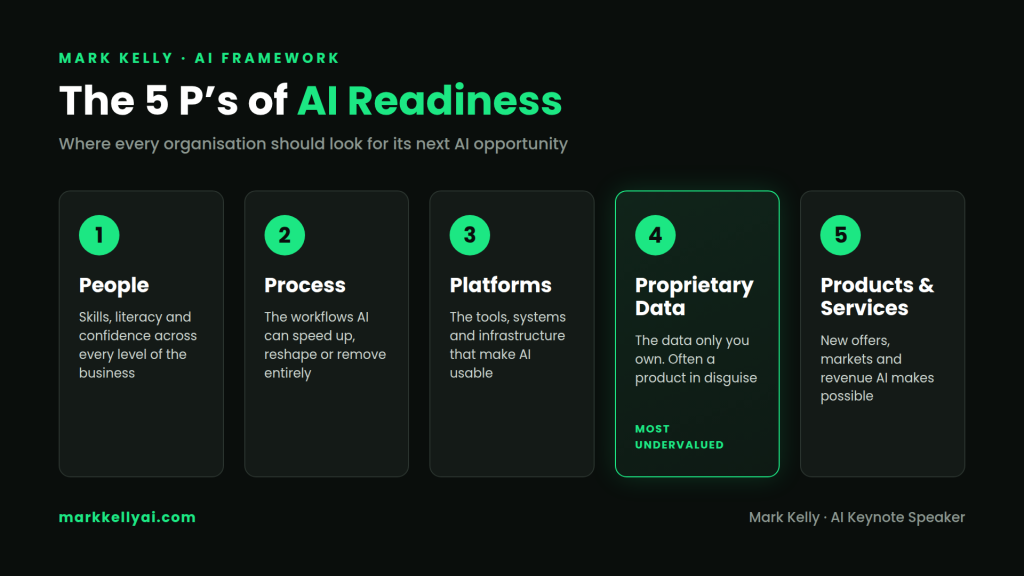
The 5 P’s of AI Readiness. Proprietary Data is the most undervalued P, and often a product in disguise.
Here is the exercise I run in executive AI workshops.
Three steps.
1. Change the question. Stop asking “what can AI automate?” Ask “what could we sell if the cost of doing X fell by 90%?” Run it for research, launches, translation, analysis and service delivery.
2. Map your 5 P’s. People, Process, Platforms, Proprietary Data, Products and Services. Pay special attention to Proprietary Data. List every dataset your business creates as a by-product. Ask what a customer, partner or new market would pay for it.
3. Pilot with a revenue metric. Most AI pilots measure hours saved. Pick one pilot and measure it in euros earned. New leads, new offers tested, new segments served. What you measure shapes what you build.
Small point, big consequence: teams given a cost target build Efficiency AI.
Teams given a revenue target build Opportunity AI.
FAQs
What is Opportunity AI?
Opportunity AI is using AI to create new revenue rather than reduce costs. New products, new markets, new partnerships and new business models. It is the counterpart to Efficiency AI, which focuses on doing existing work cheaper.
Isn’t cost saving the safer place to start?
It is a fine place to start and a poor place to stop. Efficiency gains are quickly matched by competitors using the same tools. Revenue opportunities built on your own data and customers are much harder to copy.
What topics do I cover as an AI keynote speaker on this theme?
My Opportunity AI keynotes cover the Efficiency vs Opportunity framework, real examples like the six above, the 5 P’s of AI Readiness, and a practical method leadership teams can apply the next morning. Every talk is tailored to the audience’s industry.
How long before Opportunity AI shows results?
Faster than most leaders expect. The go-to-market example above showed revenue impact within one quarter. Data products and new segments typically take six to twelve months. The key is starting with an opportunity you already have the assets for.
The Takeaway
Efficiency AI keeps you in the game. Opportunity AI wins it.
The six examples above share one trait. None required inventing new technology. Each firm pointed AI at assets it already had: data, channels, capabilities and demand it could not previously serve.
The question for your next leadership meeting is simple. Where is our supplements line? Where is our joint venture? What would we do if launching took one day instead of two weeks?
If you want your leadership team or conference audience to leave with clear answers, I deliver keynotes and executive sessions on exactly this. Get in touch at markkellyai.com hto check availability for your event.
Mark Kelly is an AI keynote speaker, strategist and board advisor. He has delivered 300+ international keynotes, trained more than 10,000 professionals, and reviewed over 1,000 real-world AI projects as founder of the AI Awards.*
Share This Story, Choose Your Platform!
Planning an event or leadership offsite?
Mark Kelly delivers evidence-based AI keynotes and hands-on AI leadership workshops for boards, executive teams and conferences across Ireland and Europe.