Ask ten business leaders what their AI strategy is, and nine will describe a product. That’s exactly backwards. A proper AI strategy framework doesn’t start with the product at all — it starts with the four things holding it up.
Ask them what’s underneath the product — the people trained to use it, the process it slots into, the platform it runs on, the data it’s fed — and the answers get shaky fast.
That gap is why most AI projects stall before they ever reach a customer.
Why This Matters
If you start with “what tool should we buy,” you’re picking paint colours before the foundation is poured. The tool is the easy part. The other four decisions are the ones that decide whether it works, scales, or quietly dies in six months.
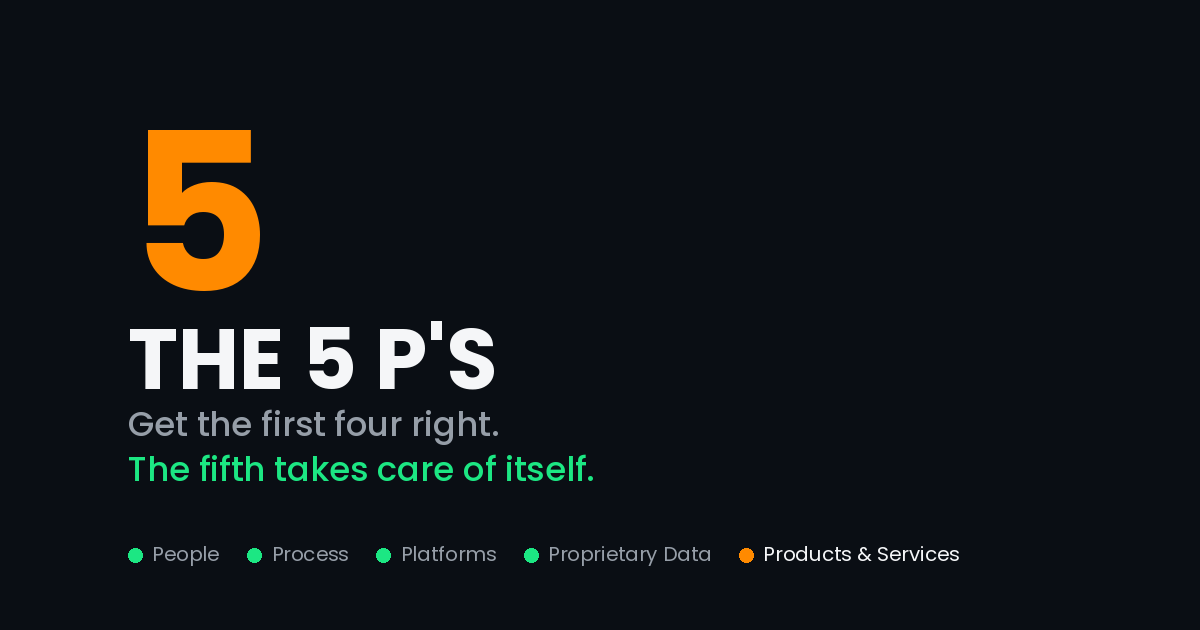
I call this AI strategy framework the 5 P’s: People, Process, Platforms, Proprietary Data, and Products & Services. Get the first four right, and the fifth stops being a gamble.
The Evidence
Look at how fast the ground moves under “Platforms” alone. Google retired its Gemini 2.0 Flash model in June 2026 — a model plenty of businesses had already built workflows around. That’s not rare. It’s routine.
Where things stand right now: enterprise AI platform data backs this up. In January 2025, the two leading AI models handled over 90% of enterprise use between them. By December that same year, four different models each held more than 10% share, and even the top model had dropped to about 23%. No single platform stays on top for long. If your AI strategy depends on one vendor never changing course, you don’t have a strategy — you have a hope.
That’s the trap. Business leaders pick the exciting part — the product, the chatbot, the shiny demo — and treat the platform underneath as a solved problem. It isn’t. It’s the part most likely to move on you.
The 5 P’s, One at a Time
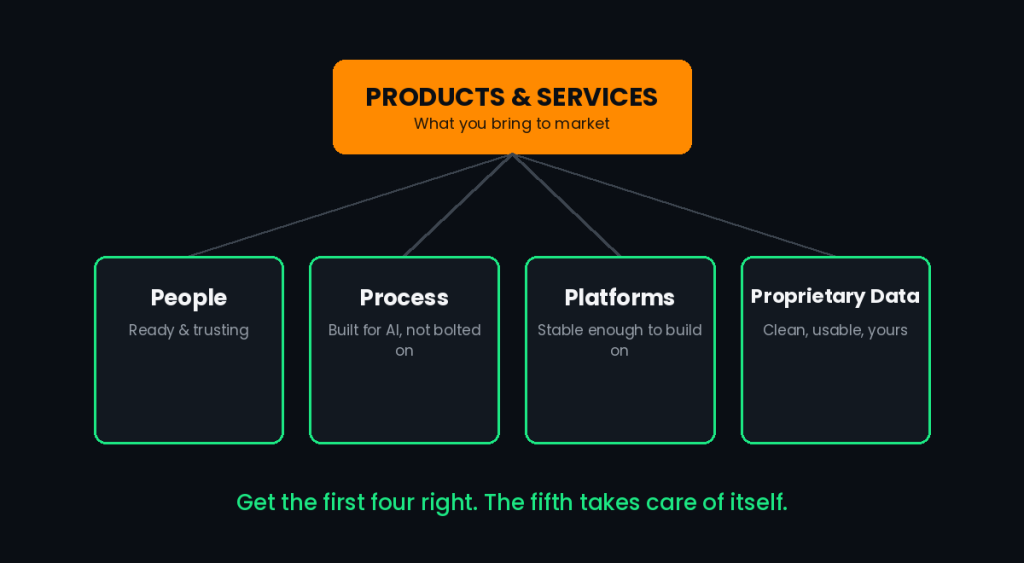
Get the first four right. The fifth takes care of itself.
People Do your team know how to use this? Do they trust it enough to actually rely on it? This is the same line I draw between tasks and jobs — AI takes over tasks, not people, but only if your people are ready to hand those tasks over.
Process Is this bolted onto an old workflow, or built into a new one? Most AI failures aren’t the model. They’re a good model dropped into a broken process.
Platforms What are you actually standing on — Microsoft, Google, an internal system, an AI-native tool? Is it stable enough to build a real business process on top of, or will it change under you in six months? Given what we just covered, plan for change. Don’t build your whole process around one model that might not exist next year.
Proprietary Data What do you know that your competitors don’t? Is it clean enough, structured enough, and accessible enough to actually use?
Products & Services Only once the first four hold up — what new offer can you genuinely bring to market?
The Big Idea
Get the first four P’s right, and the fifth takes care of itself.
What Leaders Should Do
- Score your organisation 1 to 4 on each of the first four P’s — before you talk about the product.
- Fix your lowest score first. That’s your real blocker, not the tool you’re evaluating.
- Pressure-test your platform choice against the deprecation problem. Build for change, not for one vendor’s roadmap.
- Only greenlight a new product or service once People, Process, Platforms and Data can actually support it.
Homework
Pick one AI idea sitting on your desk right now. Score it 1 to 4 on each of the first four P’s. Wherever it scores lowest — that’s this week’s job, not the launch plan.
Key Takeaway
Every AI product that fails, fails somewhere in the first four letters. Almost never the fifth.
Want help scoring your organisation against the 5 P’s? Book a session with Mark.
Sources: Gemini 2.0 Flash deprecation, June 2026 (Devstars, AI Model Costs 2026). Enterprise model-usage fragmentation data, January–December 2025 (Perplexity Enterprise, “Inside the Rise of Enterprise AI Model-Switching,” Feb 2026).
Share This Story, Choose Your Platform!
Planning an event or leadership offsite?
Mark Kelly delivers evidence-based AI keynotes and hands-on AI leadership workshops for boards, executive teams and conferences across Ireland and Europe.