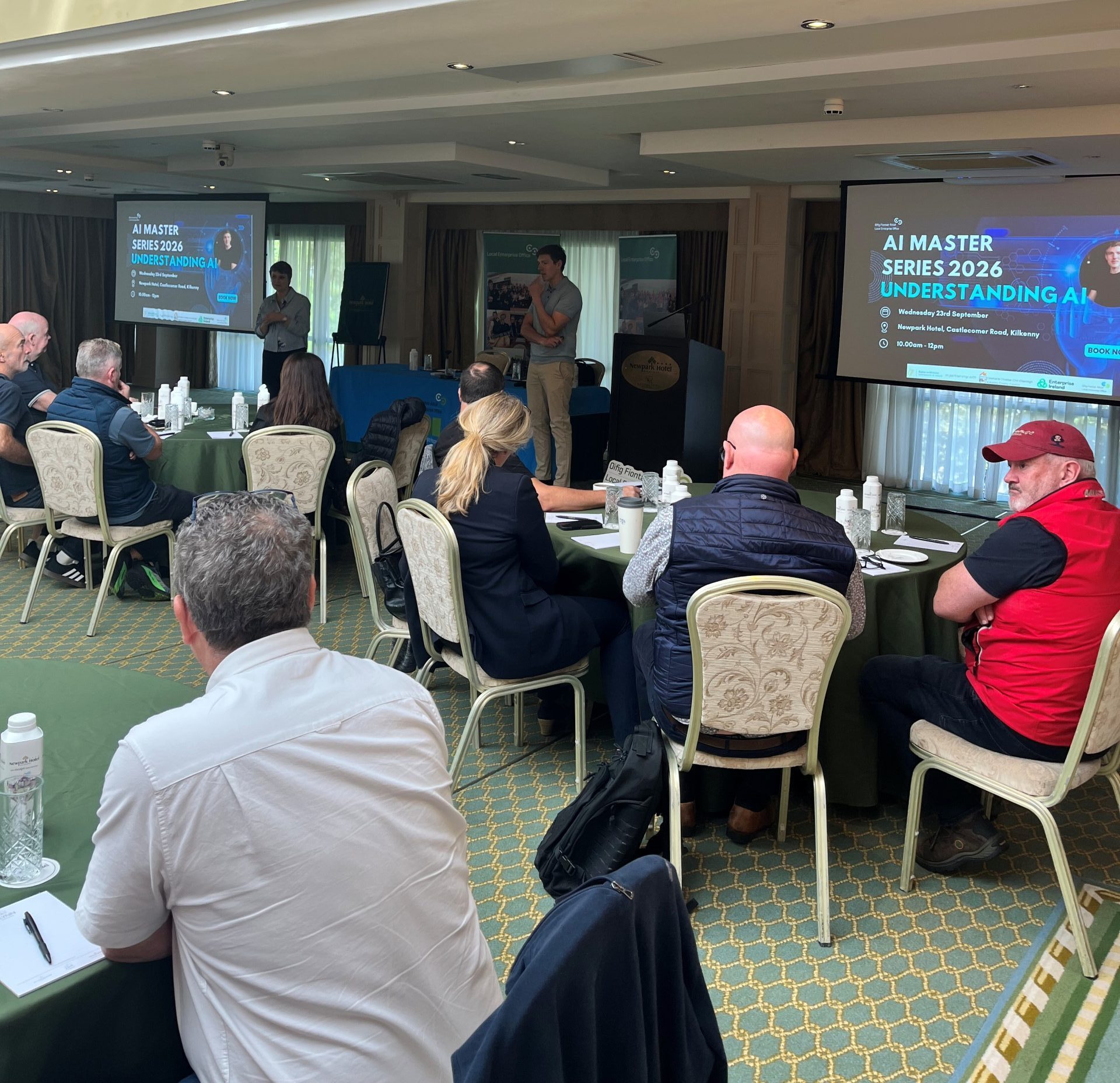
AI for small business starts with one shift. Most small businesses are using AI to ask questions. The winners are starting to hand it work. That was the big idea on AI for small business that I brought to the Local Enterprise Office AI Master Series in Kilkenny on Wednesday 23 September.
The room at the Newpark Hotel was full of owners, managers, retailers, service firms and tourism businesses. Busy people. Nobody wanted hype. They wanted to know where to start on Monday.
The event, “Understanding AI”, ran from 10am to midday at the Newpark Hotel on Castlecomer Road, as part of the AI Master Series 2026.
AI for small business: three waves so far
I open most sessions with this slide, because it explains why AI suddenly feels different.
- Ask (2022–23). Chatbots. You type a prompt, you get an answer.
- Work (2024–25). Reasoning assistants. AI can analyse, compare and pull ideas together.
- Delegate (now). AI agents. They plan, use tools, take action and report back.
The shift is simple: from asking AI questions to delegating AI outcomes. Most small businesses are still in wave one. That is fine. But the gap between wave one and wave three is where the time savings are.
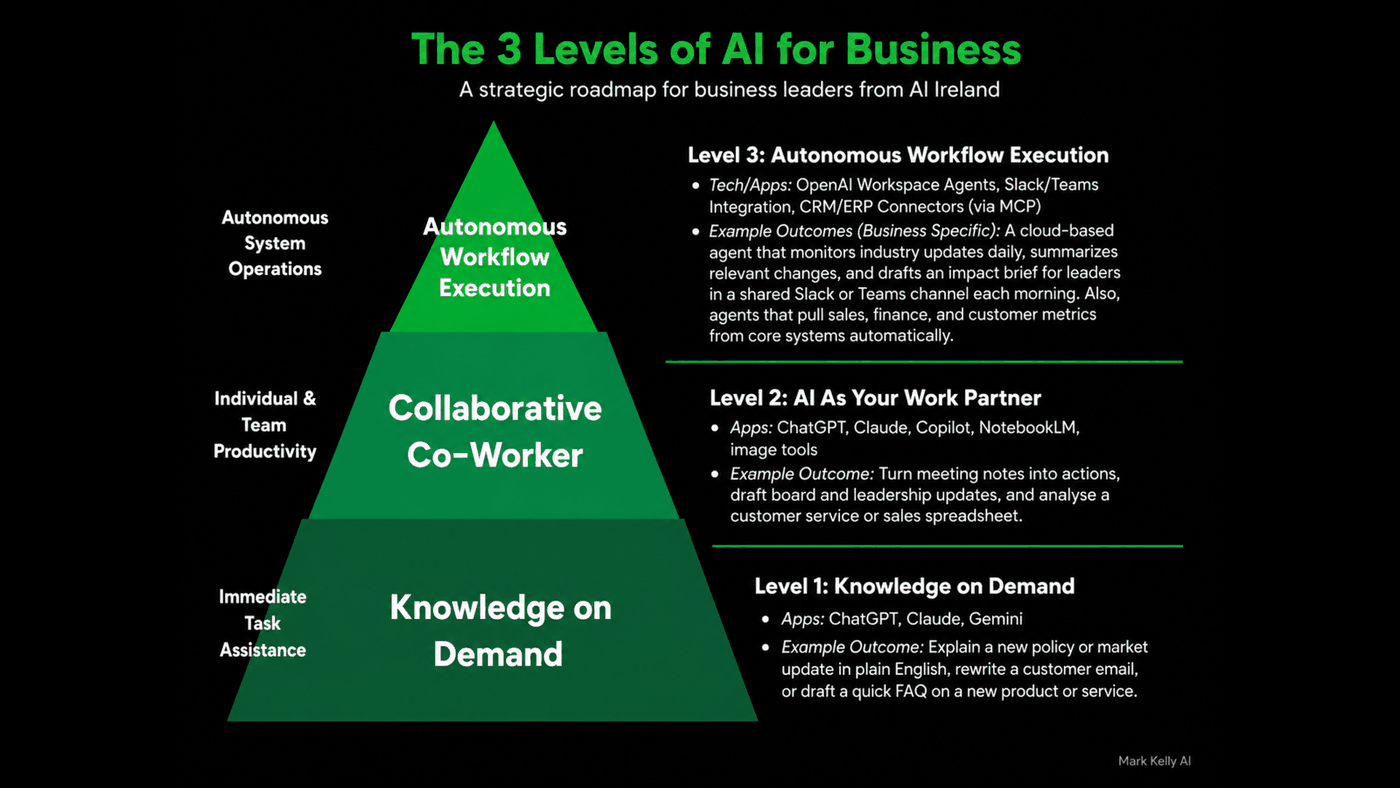
The three levels of AI in a small business
You do not need to jump straight to agents. Think of it as three levels.
- Level 1: Fast answers. Write emails, plan a trip, get ideas. Most people are here.
- Level 2: Work partner. Turn notes into actions, create slides, analyse a spreadsheet.
- Level 3: Works for you. AI runs tasks on its own: posting updates, refreshing reports, sending summaries.
Move up one level at a time. Each level builds the confidence you need for the next.
Do not start with the tool
This is the mistake I see most. Someone buys a licence, then looks for a use. Start the other way round. Start with the work people complain about.
- What takes too long?
- What gets repeated every week?
- What creates mistakes?
- What slows down decisions?
AI adoption happens in the work, not in the software menu.
Tell AI your goals, not just your question
Ask AI “What should I focus on this week?” and you get advice that is true for anyone and useful to no one. Give it a short brief first: your role, your priorities, your deadlines, your constraints. Ask the same question again. The answer changes completely.
Same tool. Your context. Your week. That is the difference between a toy and a tool.
[MARK: add the “Optimise Your Week” prompt demo result or a reaction from the room]Your customers may never click
Here is the part that surprised a few business owners. More and more customers ask AI for answers instead of searching and clicking. If AI cannot find clear information about your business, you may not be in the answer at all.
- Answer the questions buyers now ask AI, on your own website.
- Describe your services clearly, not vaguely.
- Publish proof: results, reviews and examples.
Clear expertise becomes a growth asset. Messy content becomes a commercial risk.
What LEO Kilkenny said
“Mark delivered an excellent presentation providing an overview of AI, focusing on its practical uses in the business setting and how to become an AI-Ready business. The attendees were empowered and learned about when to use AI but also, when not to use it.”
Catherine Hennessy, Senior Enterprise Development Officer, Local Enterprise Office Kilkenny
The counter-argument, before you make it
“We are too small for AI.”
The opposite is true. Large firms need committees and months of testing. A small business can try something on Tuesday and keep it on Wednesday. Your size is an advantage, as long as you practise.
What to do on Monday: practise where failure is free
Nobody practises for a future they were not told about. So start small, somewhere a wrong answer costs you nothing.
Step 1: Pick one thing at home
Not work. Food, a repair, a hobby. Ask AI to help, and watch how it responds.
Step 2: Use a photo, not a description
Snap the fridge, the broken bike or the plant. It teaches you how much context these tools need.
Step 3: Ask a second question every time
The first answer is a draft. The value is in the follow-up. Do this four times before you bring it into your business.
FAQs
Do I need to pay for AI tools to start?
No. Free versions are enough to practise and test quick wins. Pay only when a tool saves you real time every week.
Is it safe to put business data into AI?
Keep customer details, staff records and bank data out of free tools. Use approved business versions for anything sensitive, and check every answer before you use it.
What skills matter most?
Curiosity, agency and systems thinking. The tools change every quarter. Those three skills do not. Skills compound, and careers follow.
The bottom line
AI will not reward the business that knows the most. It will reward the one that learns the fastest. Start with one task, one level and one week of practice.
Thank you to the Local Enterprise Office Kilkenny for hosting the AI Master Series. If you run a business network, chamber or leadership team and want a practical session like this, check my availability, read the LEO Kilkenny case study or see my AI workshops.
Mark Kelly is an AI keynote speaker, strategist and board advisor based in Ireland. He founded AI Ireland, hosts the AI Ireland Podcast, wrote the AI Unleashed series and created the AI Awards. He has delivered 300+ keynotes and trained more than 10,000 professionals.
Share This Story, Choose Your Platform!
Planning an event or leadership offsite?
Mark Kelly delivers evidence-based AI keynotes and hands-on AI leadership workshops for boards, executive teams and conferences across Ireland and Europe.