AI Awards 2026 Finalists: 5 Lessons for Business Leaders
A boxing academy might not be the first place you would look for a lesson in AI strategy.
But Headon Boxing Academy, one of this year’s AI Awards finalists, offers an excellent example of what practical AI adoption looks like.
Its Pulse platform uses AI to identify changes in members’ behaviour that may signal they are at risk of cancelling their membership.
Rather than waiting until someone leaves, the system helps staff identify who might need a timely, personal conversation.
What interests me is not simply the technology.
It is the clarity of the business problem being solved.
As Founder of AI Ireland and the AI Awards, I’ve had the opportunity to see hundreds of AI applications across different industries.
This year, we received more than 275 applications, with 60 finalist places across 15 categories.
From healthcare and manufacturing to financial services, agriculture and education, the AI Awards 2026 finalists demonstrate how organisations are moving beyond experimentation and applying AI to real challenges.
For business leaders, there are important lessons here.
Using my 5Ps AI Readiness Framework, I want to share five observations from this year’s finalists and what organisations can learn from them.
AI Awards 2026 Finalists Announcement | Source: AI Ireland
1. People: AI Adoption Starts With Capability, Not Technology
One of the biggest mistakes organisations can make is assuming that giving employees access to AI tools automatically creates business value.
It doesn’t.
People need to understand where AI can help, how to use it effectively and when human judgement remains essential.
Take Musgrave, a finalist in the Large Enterprise category.
Its AI and Automation Factory combines automation, Microsoft Copilot, internally developed AI products and staff training.
What stands out is that the approach goes beyond technology. It includes the governance and delivery practices needed to support responsible adoption across the organisation.
Another example is Corey Duffy from Brightbeam, a finalist for Young AI Role Model of the Year.
Alongside delivering production AI systems, Corey shares engineering knowledge and mentors colleagues.
That matters because successful AI adoption should not depend on a handful of technically capable individuals.
Organisations need to develop capability across their teams.
My takeaway for leaders:
Don’t measure AI adoption solely by the number of licences purchased or employees trained.
Ask whether people are actually changing how they work and whether those changes are improving business outcomes.
Leadership question: Who in your organisation is helping others develop the confidence and capability to use AI effectively?
2. Process: Start Where Work Gets Stuck
I regularly encourage leadership teams to stop thinking about AI tools for a moment and examine how work actually happens.
Where are people repeating tasks?
Where does information get stuck?
Where are employees spending time on activities that could be simplified?
The finalists offer some excellent examples.
Headon Boxing Academy developed Pulse to help identify members who may be drifting away from their usual attendance patterns.
The AI analyses changes in behaviour and helps staff prioritise personal outreach.
The technology supports a specific business process: customer retention.
Importantly, the human relationship remains central.
Another example comes from the Mental Health Commission, a finalist in Healthcare.
It uses human-supervised generative AI to turn inspection findings into draft regulatory reports.
The system supports report preparation, while expert validation and professional accountability remain part of the process.
These examples are from very different sectors, but they share an important principle.
AI works best when it has a clearly defined job within a business process.
Too many organisations begin by asking employees to experiment with AI and hope useful applications emerge.
Experimentation has value, but eventually leaders need to identify specific workflows where AI can make a measurable difference.
My takeaway for leaders:
Start with the process, not the prompt.
Leadership question: What recurring activity in your organisation consumes significant time without creating equivalent value?

Headon Boxing Academy | Source: Headon Boxing Academy
3. Platforms: Connect the Systems You Already Have
Many organisations have spent years investing in technology.
They have customer management systems, financial platforms, operational databases, document repositories and internal applications.
Yet employees often spend considerable time moving information between them.
This is where AI agents are creating interesting opportunities.
Unum Ireland, a finalist in the Large Enterprise category, developed Small Market Big Bet.
Its approach connects existing insurance systems through multiple AI agents, supporting processes such as quoting, onboarding, enrolment and administration.
Rather than treating each system as a separate destination, the project helps connect activities across the customer journey.
Another example is Annora AI, a finalist in the Startup category.
Annora connects manufacturers’ existing systems, files and operational knowledge through a secure AI layer.
This helps teams access business information and streamline quotation workflows without requiring everything to be moved into a new system.
For me, this is an important shift.
The opportunity is not always to replace existing technology.
Sometimes it is to make the technology already in place work together more effectively.
My takeaway for leaders:
Before buying another AI platform, understand where your current systems are disconnected and what employees are doing manually to bridge those gaps.
Leadership question: Where are your employees effectively acting as the connection between two systems?
4. Proprietary Data: Your Organisation’s Knowledge Is an Asset
AI tools are becoming increasingly accessible.
But organisations have something that a general-purpose AI tool does not automatically possess.
Their own information, experience, customer knowledge and operational history.
This is where proprietary data becomes valuable.
Herdwatch, a finalist in both the SME and Sustainability categories, provides a compelling example.
Its Herd Intelligence platform allows farmers to ask questions about their own livestock records using everyday language.
Farmers can explore information relating to animal treatments, fertiliser use, weight and soil records.
The value is not simply that AI can answer a question.
It is that farmers can make better use of information already connected to their operations.
Laya Healthcare, a finalist in Consumer and Customer Service, offers another example.
Its Knowledge Hub helps customer service advisers find answers grounded in approved policy information and relevant member context.
Instead of searching through disconnected sources, advisers can access information with supporting references to assist their judgement.
These projects highlight an important opportunity.
The real value of AI often emerges when powerful technology is connected to information that is specific to your organisation.
However, this also creates responsibilities.
Information must be accurate, appropriately protected and accessible only to authorised users.
My takeaway for leaders:
Your data strategy and AI strategy should not be treated as separate conversations.
Leadership question: What valuable information does your organisation already possess that employees struggle to find, understand or use?
5. Products and Services: Look Beyond Cost Savings
When I speak with business leaders about AI, I often use a simple analogy.
Blue Euro and Green Euro.
Blue Euro represents efficiency.
Saving time, reducing repetitive work, lowering costs and improving existing processes.
Green Euro represents growth.
Creating new products, improving customer experiences, entering new markets and developing revenue opportunities.
Both matter.
But organisations that focus exclusively on efficiency risk missing some of the most interesting opportunities.
Consider SPRYT, a finalist in Agentic AI Innovation and Healthcare.
Its Asa assistant supports appointment booking, rescheduling, reminders and patient communication through familiar messaging channels.
The ambition is not simply to reduce administration.
It is also to make healthcare appointments easier to manage and improve access to services.
Examinaite, a finalist in Public Sector and Social Good, offers another example.
Its AI platform provides examination-style feedback grounded in official marking schemes, while supporting teachers with assessment preparation and marking.
This illustrates how AI can make educational support more accessible.
Neither example should be viewed solely through the lens of time saved.
They also raise questions about how organisations can improve the services they provide.
My takeaway for leaders:
Every AI strategy should consider both efficiency and opportunity.
Leadership question: If AI removed some of your current constraints, what new service or customer experience could your organisation offer?
Blue Euro vs Green Euro: Two Ways to Create Value
Across this year’s AI Awards finalists, we can see examples of both approaches.
Blue Euro: Improving the Business You Have
- Reducing repetitive administrative work.
- Helping employees access information faster.
- Improving operational efficiency.
- Supporting more consistent decisions.
- Making better use of existing resources.
Green Euro: Building the Business You Could Have
- Developing AI-enabled products.
- Creating more personalised customer experiences.
- Making services more accessible.
- Identifying new commercial opportunities.
- Delivering capabilities that were previously difficult or expensive to provide.
The important point is that these are not competing priorities.
A well-designed AI strategy should consider both.
For a Chief Financial Officer, Blue Euro may initially be easier to measure through time savings and operating costs.
But Green Euro deserves equal attention from the wider leadership team.
AI should not only help organisations do today’s work more efficiently. It should help them consider what becomes possible tomorrow.
What the AI Awards 2026 Finalists Tell Us About Business AI
Looking across the finalists, five themes stand out to me.
People matter. Organisations need to develop capability, confidence and judgement alongside technology.
Processes matter. The strongest starting point is often a clearly defined business problem.
Platforms matter. AI can help connect existing systems and reduce fragmented workflows.
Proprietary data matters. An organisation’s information and experience can make AI significantly more useful.
Products and services matter. Leaders should look beyond productivity towards customer experience, innovation and growth.
These five areas form the foundation of my 5Ps AI Readiness Framework.
They also reinforce something I regularly discuss in my executive workshops.
AI adoption is not primarily about becoming better at using AI tools. It is about becoming better at identifying and delivering business outcomes with AI.
The technology is important.
But so are leadership, organisational readiness, governance and the willingness to change established ways of working.
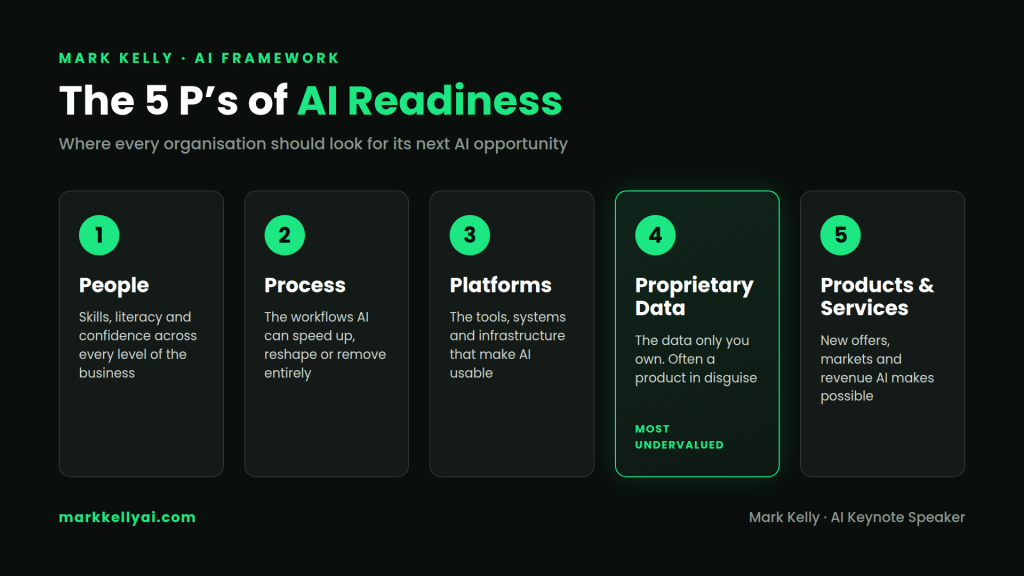
Mark Kelly’s 5Ps AI Readiness Framework | Source: Mark Kelly AI
What Should Business Leaders Do Next?
For a practical sequence from identifying a problem to measuring a pilot, read AI Adoption in 2026: 10 Lessons for Business Leaders.
You do not need to build the same technology as an AI Awards finalist to learn from its approach.
Start with one problem.
Identify the people involved.
Understand the process.
Examine the platforms and information required.
Then define the outcome you want to improve.
It might be time saved.
It might be fewer errors.
It might be a better customer experience.
Or it might be an entirely new product or service.
The important thing is to start with a business objective rather than a technology purchase.
The AI Awards 2026 finalists demonstrate the breadth of innovation taking place across Ireland and beyond.
Congratulations to all the finalists, and thank you to the judges, sponsors and wider AI Ireland community who make the awards possible.
I look forward to celebrating these achievements at the AI Awards ceremony in Dublin on 17 November 2026.
Bringing These Lessons Into Your Organisation
Through my AI leadership workshops and executive briefings, I help organisations identify practical opportunities to save time, improve decisions, create better customer experiences and adopt AI responsibly.
The focus is not simply AI training.
It is helping leadership teams turn AI potential into measurable business outcomes.
Explore my AI Leadership Workshops
Frequently Asked Questions About the AI Awards 2026
What are the AI Awards 2026?
The AI Awards, organised by AI Ireland, recognise AI innovation across business, research, public services and society.
What can business leaders learn from the AI Awards finalists?
The projects illustrate practical approaches to AI adoption, including workflow improvement, making better use of data, developing employees and responsible deployment.
When are the AI Awards 2026?
The AI Awards 2026 ceremony takes place on 17 November 2026 in Dublin.
About Mark Kelly
Mark Kelly is the Founder of AI Ireland and the AI Awards, and an AI keynote speaker and executive advisor.
Through Mark Kelly AI, he works with CEOs, boards and leadership teams to support practical AI adoption, using his 5Ps AI Readiness Framework to connect technology opportunities with business outcomes.
Share This Story, Choose Your Platform!
Planning an event or leadership offsite?
Mark Kelly delivers evidence-based AI keynotes and hands-on AI leadership workshops for boards, executive teams and conferences across Ireland and Europe.