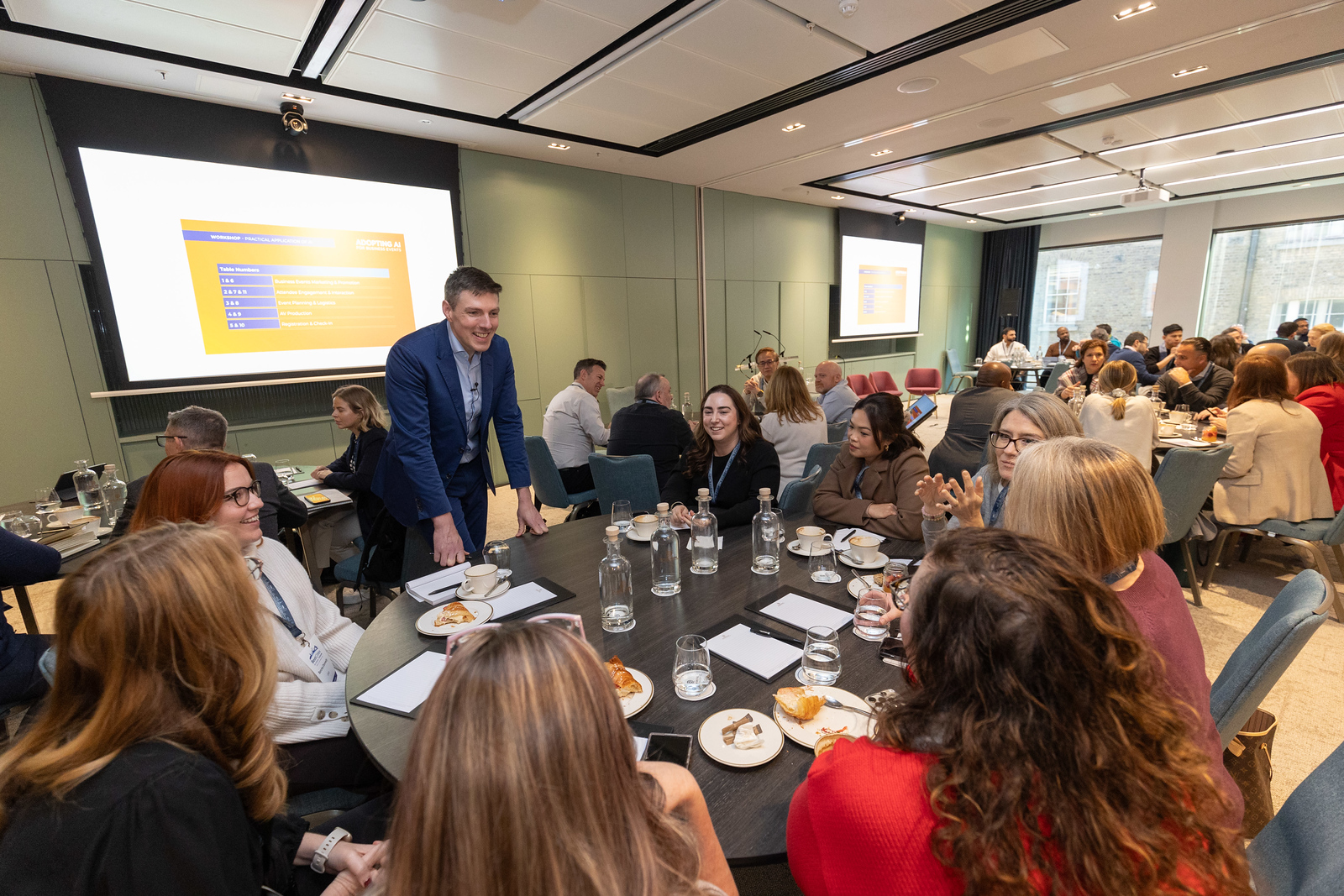
Before booking an AI workshop, ask one question:
What should our team be able to do differently afterwards?
Understanding the technology is useful. Seeing a demonstration can make the possibilities clearer. But a leadership workshop should help people make decisions about their own organisation.
Where could AI improve the work? What needs to be in place? Who will take responsibility for the next step?
My AI leadership workshops bring together practical examples, discussion and exercises tailored to the organisation. Here is what I believe leaders should look for when planning a session.
Start with a business problem
“We need to do something with AI” is a starting point for a conversation. It needs to become a more specific brief.
Perhaps your managers spend too much time preparing reports. Customer enquiries take too long to reach the right person. Valuable information is difficult to find. Teams are experimenting with tools, but nobody knows which approaches are worth keeping.
Choose a problem people recognise.
For example, instead of asking whether AI could improve sales, ask:
Could we reduce the time spent preparing a first proposal while maintaining accuracy and relevance?
That gives the workshop a process to examine, people to involve and an outcome to test.
It also leaves room for an honest answer. The biggest obstacle might be inconsistent information or an unclear approval process. Buying another tool may not solve it.
Ground the workshop in your team and real Irish examples
A useful workshop starts before the session.
Preparation can include a pre-workshop AI readiness survey to establish where leaders feel confident, where they are uncertain and which business problems they want to address. Those responses give us a basis for tailoring the discussion and identifying differences in priorities across the team.
My work through AI Ireland and the AI Awards brings another perspective: examples of how organisations across Ireland are applying AI. The finalists provide a window into the opportunities being pursued, the problems being tackled and the questions leaders should ask.
In my AI Awards leadership article, I explore how those examples connect with business readiness. Finalist stories offer useful evidence to examine; they are not a representative survey of every Irish organisation or independent verification of every reported outcome.
We can use those examples to examine your own situation. What would a similar approach require in your organisation? Is your information ready? Who would own the process? What evidence would justify taking it further?
The aim is to connect your team’s starting point with relevant examples and a practical next step.
Use the 5Ps to assess readiness
I use five areas to structure the discussion: People, Process, Platforms, Proprietary Data, and Products & Services.
Each reveals a different part of the work required.
People
Who will use the system? What do they understand already? Where do they need support?
Include the people who do the work. They often know where information is missing, which exceptions cause delays and why a seemingly simple task takes longer than expected.
Agree who will own the change and who will review the output.
Process
Map what happens today.
For a proposal, that might include receiving the brief, clarifying requirements, finding relevant examples, drafting the response, checking prices and securing approval.
Identify the specific step AI might help with. Improving one well-defined task is easier to assess than attempting to automate an entire process at once.
Platforms
Establish which tools the organisation has approved and what they can access.
A demonstration using a personal account may not reflect what employees can do in their working environment. Permissions, licences and integrations need to be understood before a pilot begins.
Proprietary Data
Consider the information the task depends on.
Is it accurate? Is it current? Can the right people access it? Is it appropriate to use in the proposed system?
A proposal assistant working from outdated service descriptions could produce a polished answer that promises something the business no longer offers.
Products & Services
Ask how the change could improve what customers receive.
Could it make a response more useful? Reduce avoidable waiting? Help staff prepare better? Support a new service?
Time saved is valuable. So are better quality, clearer decisions and improved customer experiences. Define which outcome matters for this project.
Make demonstrations useful to the decision
A demonstration should give the team something to examine.
Using our proposal example, imagine a prepared exercise with fictional customer details and an approved sample service description.
An AI tool produces a first draft. The team then checks it:
- Has it understood the brief?
- Has it invented a price, capability or commitment?
- What information is missing?
- How much editing does it need?
- Who must approve it before it leaves the organisation?
This is an illustrative exercise, not a reported client result.
Its purpose is to make the review process visible. A fluent answer can still contain an error. The person checking it needs enough knowledge to recognise that.
If the system can take action, such as sending the proposal, the discussion must also cover its authority and approval boundaries.
Choose a small number of opportunities
A workshop can generate more ideas than a team has capacity to deliver.
Before leaving the room, compare the strongest candidates against practical questions:
- Does this solve a meaningful problem?
- Do we have suitable information and tools?
- Can someone own the work?
- Can we test it on a manageable scale?
- Can we measure whether it helps?
An idea may have considerable potential but need preparation first. Another may offer a smaller benefit and be ready to test.
Both are useful conclusions. The team needs to understand why it is choosing one opportunity ahead of another.
Agree how you will measure progress
“People liked the tool” tells you something about their experience. It does not establish that the process improved.
For the proposal example, a pilot could compare:
| Measure | What to record |
|---|---|
| Time | Drafting, checking and correcting time |
| Quality | Missing requirements, factual errors and rework |
| Usefulness | Whether the reviewer considers the draft fit for purpose |
| Adoption | Whether staff use it for suitable tasks |
| Cost | Tool costs and the effort required to maintain it |
Record a baseline before introducing the change. Compare similar tasks where possible.
A faster first draft may still require enough correction to remove the apparent saving. Equally, a tool might improve quality without reducing total time. Decide what would count as a worthwhile result.
Leave with ownership and a review date
The next step should be clear enough to put in someone’s diary.
A practical pilot brief should name:
- The problem and the task being tested.
- The person responsible.
- The approved tools and information.
- The checks and approval boundaries.
- The measures of success.
- The date for reviewing the evidence.
At that review, the team should be able to decide whether to continue, adjust or stop.
Finding that an approach does not help is useful if the test was small and the learning is clear.
Decide whether you need a keynote, a workshop or both
A keynote can give a wider audience a shared understanding of AI and the questions it raises.
A workshop gives a smaller group time to examine its own work, compare options and agree actions.
Choose the format around the outcome you need. My guide to choosing an AI keynote speaker covers the questions to ask when assessing evidence, audience fit and delivery.
For either format, preparation matters. Tell the facilitator who will attend, what decisions you face and what would make the session worthwhile.
What clients say
“His ability to combine deep expertise with clear communication and hands-on methodology made the day both inspiring and productive. We can highly recommend Mark Kelly to any organization seeking a thought-provoking, engaging, and expertly delivered program on Artificial Intelligence.”
Chief Digital Officer, LEG Group
“Mark’s sessions are consistently among the highest-rated. He combines strong subject-matter expertise with the ability to make complex AI concepts clear, practical, and directly relevant to business audiences of varying experience levels.”
CEO, German-Irish Chamber of Industry & Commerce
Explore AI leadership and keynote case studies.
Planning an AI workshop for your leadership team?
Bring a business problem you want to examine.
It might involve repetitive administration, slow responses, difficult access to information or uncertainty about where to begin.
We can discuss your team’s experience, priorities and working environment, then identify an appropriate session.
Share This Story, Choose Your Platform!
Planning an event or leadership offsite?
Mark Kelly delivers evidence-based AI keynotes and hands-on AI leadership workshops for boards, executive teams and conferences across Ireland and Europe.