An impressive AI demonstration can show what a tool is capable of.
It cannot tell you whether your organisation is ready to use it well.
That requires a different discussion. Do your people understand the task? Is the process clear? Can the technology access suitable information? Who will review the result? What should improve for your customers?
My work through AI Ireland brings together several perspectives on those questions: AI Awards projects, conversations with practitioners on the AI Ireland Podcast, and leadership research.
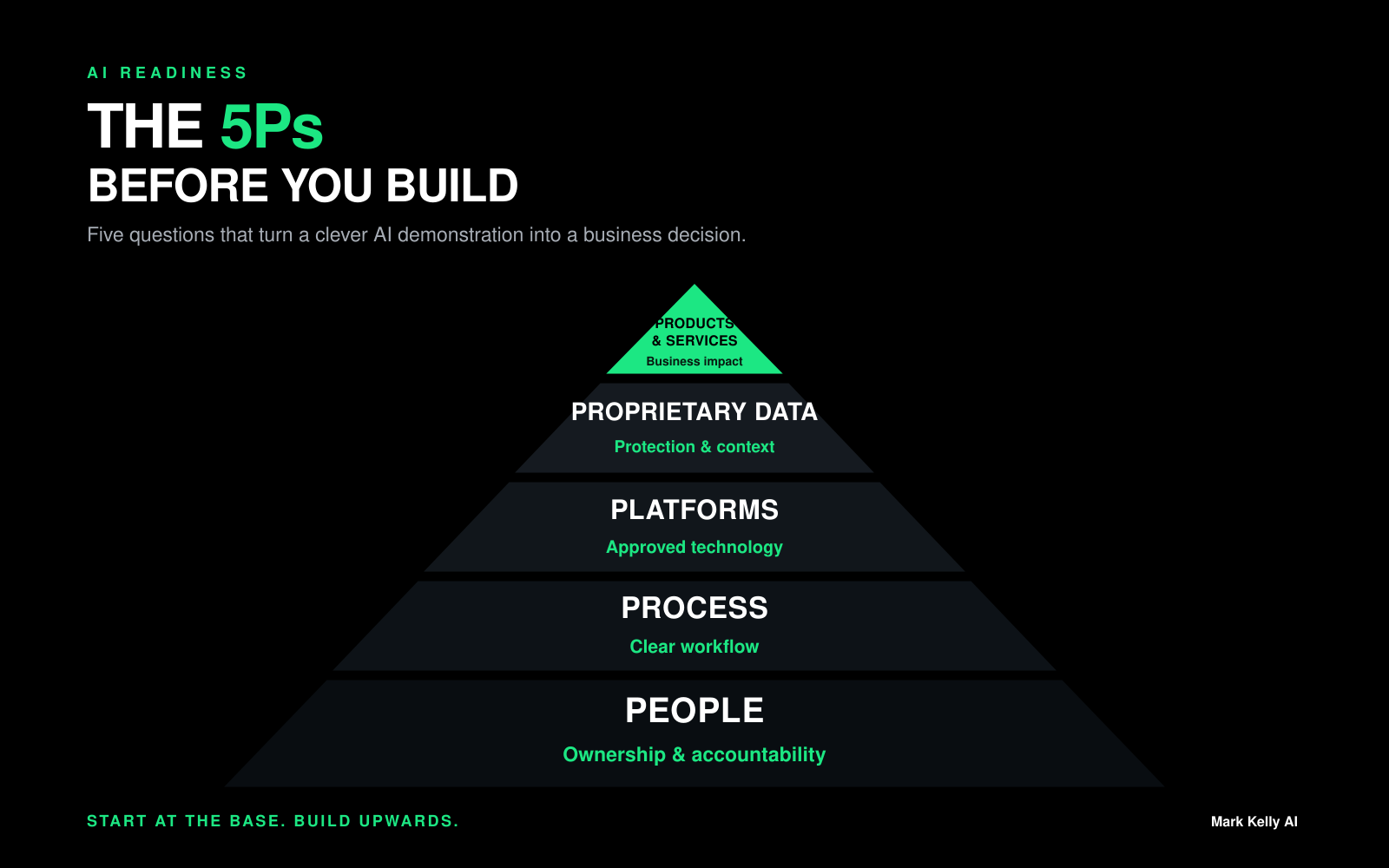
I use the 5Ps—People, Process, Platforms, Proprietary Data, and Products & Services—to turn those perspectives into practical decisions.
Here is how to apply them before your next AI investment.
1. People: Can your team use and challenge the system?
Musgrave Group’s AI and Automation Factory, shortlisted in the 2026 Large Enterprise category, combines technology with staff training, governance and delivery practices. AI Awards 2026 finalists
The leadership lesson I draw from that description is that access to a tool is only one part of adoption.
People also need to understand which tasks are appropriate, what information they may use and how to recognise an unreliable result.
In the AI Ireland Podcast’s published recap of my conversation with Expleo’s Rebecca Keenan, the themes included clear communication and hands-on involvement in helping people embrace AI. Podcast recap: Rebecca Keenan, episode 207
For your team, ask:
- Who will use the system regularly?
- What support will they need?
- Can they recognise a plausible but incorrect answer?
- Who can they ask when they are uncertain?
Readiness check: Name the users, the support they need and the person responsible for helping them.
A leadership readiness survey can reveal differences in confidence and priorities before a workshop. Follow it with practical exercises: confidence alone does not establish competence.
2. Process: Do you understand the work you want to change?
Novartis’ finalist project uses AI to help turn clinical trial feasibility surveys into information supporting trial planning. Published finalist summary
That provides a concrete starting point: a defined information task within a broader process.
Apply the same discipline to your own opportunity.
Instead of “use AI in operations”, identify a specific step. Perhaps staff spend time gathering information for a weekly report or preparing a first response to an enquiry.
Map what happens before and after that step.
Where does the information come from? What makes a case unusual? Who checks the output? What happens if the system cannot complete the task?
Readiness check: Describe the current workflow, its exceptions and the proposed change on one page.
If the team disagrees about how the work happens today, resolve that before automating it.
3. Platforms: Can the tools support the actual workflow?
Rebecca Keenan’s podcast recap also highlights examining existing AI-enabled tools before adopting additional technology. AI Ireland podcast highlights
That is a useful question for a leadership team: what can we already do with the systems we have approved?
An existing tool may be sufficient for a first test. Equally, it may lack the permissions, connections or controls the task requires.
Ask your technical team to explain:
- What the system can access.
- What it can change.
- Where human approval can be enforced.
- How actions and errors are recorded.
- How access can be withdrawn.
A demonstration in a separate environment does not establish that the same workflow will work inside your organisation.
Readiness check: Confirm that the proposed approach is technically feasible within your approved environment.
For systems that take actions, use my AI agent permissions checklist to structure the discussion.
4. Proprietary Data: Is your information ready to answer the question?
Herdwatch’s Herd Intelligence allows farmers to ask questions about their livestock records, connecting farm information with agricultural knowledge through a conversational interface. AI Awards 2026 finalists
The question this raises for another business is simple: what information would make an answer useful in your setting?
A general answer about customer service is different from an answer grounded in your current policies. A proposal based on your approved services is different from one assembled from assumptions.
Identify the information the task needs. Check its accuracy, ownership, access restrictions and update process.
Then consider missing or conflicting information. What should the system do when two documents disagree?
Readiness check: Identify an accountable owner for each essential information source.
You do not need to organise every document in the business before testing a narrow task. You do need to understand the information that task depends on.
5. Products & Services: What should become better for the customer?
SPRYT’s Asa supports appointment booking and patient communication through familiar messaging channels. Published finalist summary
That example invites leaders to consider the experience of the person using a service.
Internal efficiency matters. So does whether a customer can complete what they came to do.
For your proposed project, ask:
- Will the response become more useful?
- Will people wait less?
- Will mistakes or repeat contacts decrease?
- Can someone reach a person when needed?
- Could the change create a new frustration?
These are suggested measures for your own project, not claims about SPRYT’s results.
Readiness check: Define the customer or business outcome, its baseline and how you will assess change.
My guide to measuring AI value explains how to turn that into a manageable pilot.
Bring the five checks together
Use this table in your next leadership meeting:
| Area | Evidence to bring |
|---|---|
| People | Named users, training needs and support owner |
| Process | Current workflow, exceptions and proposed change |
| Platforms | Approved tools, access and technical requirements |
| Proprietary Data | Required sources, quality checks and ownership |
| Products & Services | Intended outcome, baseline and measures |
For each area, record ready, needs work or unknown, with a short explanation.
This is a discussion tool, not a validated scoring system. Avoid averaging the answers into a reassuring number. One unresolved issue—such as inappropriate data access—may prevent the proposed pilot from proceeding.
The useful output is a list of actions, owners and decisions.
What my perspective adds
The Awards give me concrete projects to examine across different sectors. Podcast conversations add practitioners’ accounts of implementation and change. Leadership research helps frame the wider adoption questions.
The value comes from connecting those perspectives to the problem in front of your team.
A finalist example can suggest an opportunity. A practitioner’s insight can expose a preparation task. The 5Ps help organise what your business needs to establish next.
Finalist summaries describe shortlisted work; they are not independent verification of every outcome. The questions and readiness checks in this article are my interpretation of what leaders can usefully examine.
Bring one opportunity to the discussion
You do not need a complete AI strategy before starting a useful conversation.
Bring one process you want to improve, the people who understand it and an honest account of what remains uncertain.
We can use a leadership readiness survey, relevant examples and the 5Ps to decide what is ready to test and what needs preparation.
Discuss an AI leadership workshop for your team, or read what a workshop should deliver.
Share This Story, Choose Your Platform!
Planning an event or leadership offsite?
Mark Kelly delivers evidence-based AI keynotes and hands-on AI leadership workshops for boards, executive teams and conferences across Ireland and Europe.