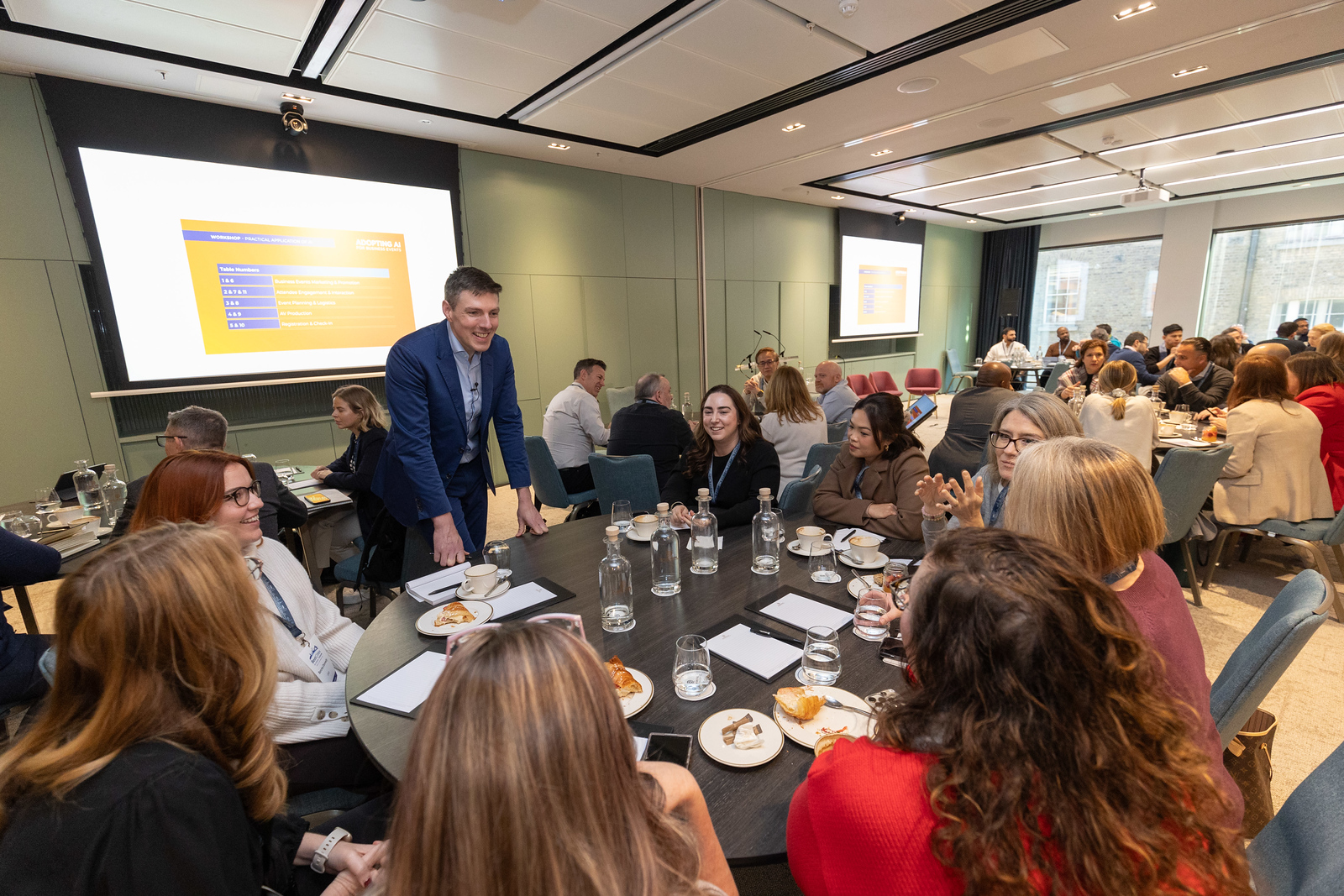
By Mark Kelly, Founder of AI Ireland and AI keynote speaker
Your team has attended an AI session. They have seen the demonstrations. Some have started experimenting.
What should happen when they return to work?
That is where AI change management becomes practical. It means helping people adopt a different way of working: choosing a useful task, understanding the boundaries, practising and checking whether the change improves the result.
As Founder of AI Ireland and the AI Awards, and host of the AI Ireland Podcast, I can examine this question from two connected perspectives. The Awards reveal projects being developed across sectors. The podcast lets me explore the decisions and challenges behind AI adoption with practitioners.
Putting those perspectives together leads me to a simple recommendation: judge an AI learning programme by what people can do afterwards.
What the AI Awards 2026 finalists bring to the discussion
Three published finalist summaries provide useful starting points. These are descriptions of shortlisted work, not independent evaluations of its results.
Musgrave: connect learning with operational delivery
Musgrave’s AI and Automation Factory combines staff training, Microsoft Copilot, automation and internally developed AI products, supported by governance and delivery practices.
The leadership question I take from this is: where does an employee’s idea go after the training session? Someone needs to assess it, support a trial and decide whether it belongs in everyday work.
Uisce Éireann: connect capability with a service people depend on
Uisce Éireann’s sustainability entry brings together AI for water operations, workforce learning and governance.
For another organisation, the useful question is which operational problem staff should be better equipped to address. That gives learning a purpose beyond becoming familiar with a tool.
TeachersTech: make the use relevant to the role
TeachersTech’s public-sector entry describes curriculum-verified planning in English and Irish, with professional judgement retained.
It prompts a concrete question: can people recognise their own work in the examples used to teach them?
Read the AI Awards 2026 finalist summaries.
Two podcast insights: access and practice
In my 2025 conversation with Microsoft Ireland’s Kieran McCorry, we explored uneven AI adoption within organisations and the need for accessible training tailored to job functions. The published episode summary highlights differences in access and use between organisational levels.
My takeaway is to check who can actually participate.
A senior team may have access to approved tools and time to experiment while colleagues delivering the service have neither. Before interpreting limited use as resistance, ask whether people have the access, guidance and opportunity they need.
Explore the Kieran McCorry episode on AI skills and the Irish workforce.
My conversation with ExamFly founder Deirdre Lyons adds another perspective. We discussed professional learning, the gap between knowing something and applying it, and ExamFly’s use of interactive testing and personalised learning.
For workplace AI training, I would apply that distinction directly. Watching someone produce an impressive answer is different from recognising when an answer is incomplete, unsupported or unsuitable for the task.
Give people a realistic exercise. Let them inspect the result, explain what they would change and try again. That creates something a manager can review beyond attendance.
Explore the Deirdre Lyons episode on professional learning.
What should change in the working day?
Here is the approach I recommend for a bounded workplace pilot. It is a practical application of the evidence above, not a claim that each finalist follows this exact process.
1. Choose one recurring task
Be specific about the work and its intended outcome. “Use AI more” gives a team little direction.
A proposed pilot might help an account manager prepare a meeting brief from approved account notes. The aim could be to reduce preparation time while preserving accuracy and identifying gaps that require a conversation.
Record how the task works today before changing it.
2. Define what the person remains responsible for
For that meeting brief, agree which information can be used, what needs checking and who approves any material shared outside the team.
Include a fallback. If the assistant cannot find reliable evidence, the user needs to know whether to consult the source, ask a colleague or complete the task manually.
3. Practise with realistic exceptions
Use approved or synthetic examples that include missing information, conflicting dates and an outdated instruction.
Ask participants to explain their decisions. Can they spot the problem? Can they correct it? Do they know when to stop?
These exercises test judgement alongside tool use.
4. Give the manager a role
Someone must make time for practice, review examples and help resolve problems. Otherwise, the employee is left to fit a new process around an unchanged workload.
A short team review can ask what helped, what created extra work and what needs changing before the next attempt.
5. Decide whether to keep, change or stop the pilot
Compare the new approach with the baseline. Include checking and correction time, not just the time taken to generate a draft.
If the tool makes the first step faster but creates more work later, investigate that before expanding it.
Measure useful adoption
Attendance and logins can show participation. A stronger review also examines:
- Quality: Is the finished work accurate and suitable?
- Total effort: What happens to preparation, review and rework?
- Judgement: Can people identify an unreliable result and respond appropriately?
- Continued use: Does the approach remain useful after the initial exercise?
- Service: Does the change improve the result for the next person in the process?
Discuss the findings with the people doing the work. Low use may point to a poor fit, unreliable information or an awkward process. It should trigger investigation.
My guide to measuring AI value explains how to connect a pilot with a business outcome.
Use the 5Ps to find what is missing
This is where I use the 5Ps: People, Process, Platforms, Proprietary Data, and Products & Services.
A training request may reveal a People need. But the obstacle could also be an unclear process, unavailable platform, unreliable information or uncertainty about the service being improved.
Identify that obstacle before booking another general training session. My AI readiness checklist provides a starting point.
Bring the adoption question to your leadership event
The perspective I bring to a keynote comes from connecting examples across sectors with conversations about how people work.
Musgrave, Uisce Éireann and TeachersTech operate in different settings. The podcast discussions add questions about access and learning. Together, they give a leadership audience concrete decisions to examine in its own organisation.
For a conference or leadership offsite, I can use these examples to help your audience identify a useful task, the conditions for adoption and what evidence to review next.
Share This Story, Choose Your Platform!
Planning an event or leadership offsite?
Mark Kelly delivers evidence-based AI keynotes and hands-on AI leadership workshops for boards, executive teams and conferences across Ireland and Europe.