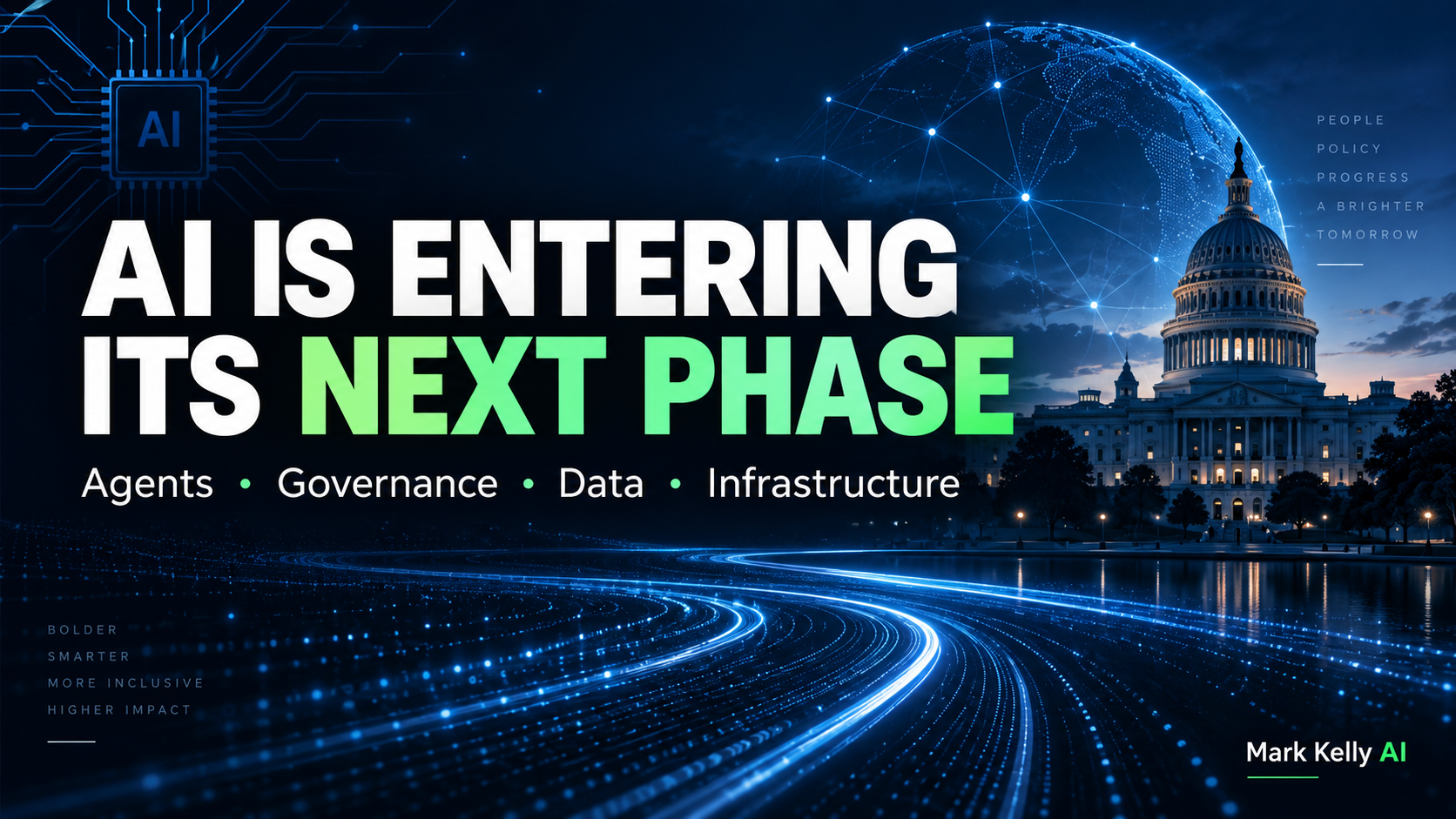
AI for business leaders is entering a very different phase.
Until recently, most business conversations about artificial intelligence focused on tools.
Which model should we use?
Should we buy Microsoft Copilot?
Should employees use ChatGPT?
How can AI help us write faster, analyse documents or automate repetitive work?
Those questions still matter.
But the conversation taking place at the highest levels is becoming much bigger.
On 29 September 2026, US President Donald Trump brought together senior leaders from companies including OpenAI, Anthropic, Nvidia, Meta, Google and SpaceX to discuss the future development of artificial intelligence.
One of the outcomes was a voluntary AI safety agreement in which companies committed to internal controls, safeguards and independent auditing of increasingly powerful AI systems.
The meeting also focused heavily on the expansion of AI data centres and introduced another phrase into the conversation: Super Intelligence.
For business leaders, the terminology is probably the least important part.
The real message is this:
AI is rapidly becoming business infrastructure.
And that changes how organisations need to think about it.
Why AI for business leaders is becoming a bigger issue
The next phase of AI is not simply about helping employees write faster or summarise documents.
AI is moving closer to business processes, decision-making, customer interactions and operational systems.
For AI for business leaders, this means the conversation has to move beyond licences and tools.
Leadership teams increasingly need to think about governance, data, workflows, accountability and where AI can create measurable business value.
AI governance is moving from policy documents to operating controls
Perhaps the most important part of the summit was the focus on how increasingly powerful AI systems should be controlled.
The companies involved committed to implementing safeguards, monitoring how systems behave and working with independent auditors to assess whether systems operate as intended.
The agreement is voluntary rather than legislation, and critics have questioned whether companies should effectively be responsible for defining and policing their own safety standards.
There are also questions around accountability and what happens when something goes wrong.
But there is a lesson here for every organisation adopting AI.
Governance cannot simply be a document sitting somewhere on SharePoint.
It has to become part of how AI actually operates.
For example:
- Who is allowed to use which AI systems?
- What information can employees put into them?
- When must a human approve an AI-generated decision?
- How do we check whether an AI agent performed the task correctly?
- Who is accountable when an automated process fails?
- Can we reconstruct what happened afterwards?
This is the difference between having an AI policy and having AI controls.
As AI moves from answering questions to taking actions, that distinction becomes much more important.
AI agents change the risk equation
There is a big difference between AI that generates an answer and AI that performs a task.
A chatbot might draft an email.
An AI agent could potentially read the email, decide what needs to happen, access another system, update a customer record, schedule a meeting and send the response.
The second scenario creates much more value.
It also creates more risk.
The White House agreement specifically included safeguards designed to prevent AI systems from accessing technical systems in unintended ways.
That is an important signal.
The next phase of enterprise AI is not simply:
Ask → Answer
It increasingly becomes:
Request → Decide → Act → Verify
For organisations, one principle becomes extremely important:
Verification > Generation
Generating something with AI is easy.
Knowing whether the output is accurate, appropriate and authorised is where much of the real work begins.
The AI race is becoming an infrastructure race
Another major topic at the meeting was data centres.
Artificial intelligence might feel like software when we interact with ChatGPT or Copilot, but underneath these systems sits enormous physical infrastructure.
- Chips
- Servers
- Electricity
- Cooling
- Networks
- Data centres
The summit reinforced US support for continued expansion of this infrastructure, despite debate around electricity demand, community impact and the location of new data centres.
Nvidia CEO Jensen Huang described these facilities as “super intelligence factories”, illustrating how strategically important computing infrastructure has become.
For most businesses, however, you do not need to build a data centre.
Your competitive advantage will come from somewhere else.
Proprietary data becomes more important
If every organisation eventually has access to powerful AI models, access to the model itself becomes less distinctive.
The advantage increasingly comes from what you connect the intelligence to.
- Your customer knowledge
- Your processes
- Your documents
- Your operational systems
- Your intellectual property
- Your historical decisions
- Your internal expertise
- Your proprietary data
Think about two companies using exactly the same AI model.
Company A gives the system a basic prompt.
Company B connects it safely to twenty years of customer knowledge, operational information, internal processes and expert guidance.
They may technically be using the same AI.
But they are not getting the same intelligence.
This is why proprietary data is one of the most important parts of AI readiness.
AI is becoming cheaper and more widely available. Intelligence alone will not necessarily be the differentiator. Context will.
The name may change. The leadership challenge does not
One of the most unusual developments from the summit was the move by the US administration towards using the term Super Intelligence rather than Artificial Intelligence in government communications.
US government departments and agencies were instructed to begin using the terms “SI” and “Super Intelligence” in official correspondence, reports and websites.
Whether that terminology becomes widely adopted remains to be seen.
For businesses, I would not spend too much time worrying about the label.
AI.
Generative AI.
Agents.
Artificial General Intelligence.
Super Intelligence.
The names will continue changing.
The leadership questions are far more consistent.
- Where can this technology create measurable value?
- Where should we automate?
- Where should humans remain in control?
- What data should AI be allowed to access?
- How do we protect customers and employees?
- How do we make sure adoption actually happens?
- What new products, services or business models become possible?
Those are business questions, not technology questions.
What should leaders do now?
For AI for business leaders, the practical starting point is to look at readiness across five areas.
People
Do employees understand how to use AI effectively and responsibly?
Process
Which repetitive or high-friction processes could be redesigned using AI?
Platforms
Do we have the right AI tools, systems and technology environment?
Proprietary Data
Can AI safely access the organisational knowledge and information that creates competitive advantage?
Products & Services
Could AI improve what we currently sell, improve the customer experience or create entirely new revenue opportunities?
This is where I would encourage leadership teams to focus.
Not on trying to predict whether we should call this AI or Super Intelligence.
Not on chasing every new model announcement.
And not on deploying AI simply because competitors are doing it.
Instead, ask a much simpler question:
Where can AI create measurable business value while keeping humans appropriately in control?
That might mean:
- Saving employees five hours per week
- Removing repetitive administrative work
- Giving managers better information before making decisions
- Improving customer response times
- Automating part of a workflow
- Building an AI agent around an internal process
- Using proprietary organisational knowledge to create something competitors cannot easily replicate
The bigger shift for AI for business leaders
The White House summit is another sign that AI is moving beyond the experimentation phase.
Governments are thinking about regulation and national infrastructure.
Technology companies are thinking about increasingly autonomous systems.
Businesses are starting to think about AI agents and redesigned workflows.
And employees are moving from occasionally experimenting with AI to incorporating it into everyday work.
The important question for leadership teams is therefore changing.
It is no longer:
“Should we use AI?”
Increasingly, it is:
“How do we build an organisation that can use AI well?”
That requires more than buying licences.
It requires people, processes, platforms, proprietary data and products and services to evolve together.
The organisations that get this right will not necessarily be those with access to the smartest AI model.
They will be those that learn how to combine powerful AI with their own people, knowledge, processes and customers.
That is where the real advantage will be built.
About Mark Kelly
Mark Kelly works with leadership teams and organisations on practical AI adoption, AI readiness, executive education and AI strategy.
His focus is helping organisations move from AI experimentation towards measurable business outcomes, including saving time, reducing repetitive work, improving decisions, creating better customer experiences and building safer ways of working.
If your organisation is looking to develop a practical approach to AI adoption, explore the executive briefings, leadership workshops and AI adoption programmes available through Mark Kelly AI.
Share This Story, Choose Your Platform!
Planning an event or leadership offsite?
Mark Kelly delivers evidence-based AI keynotes and hands-on AI leadership workshops for boards, executive teams and conferences across Ireland and Europe.