By Mark Kelly, Founder of AI Ireland and AI keynote speaker
For an SME in Ireland, a useful first AI project should address a recurring business problem with information you can trust and an outcome you can check.
That could mean finding an answer in company records, preparing a quotation or checking a tender response for missing evidence. Start with one task, keep a person responsible for the result and measure the work required from beginning to end.
Through the AI Awards, I examine projects across different sectors. On the AI Ireland Podcast, I explore the choices behind AI adoption with practitioners. Connecting those perspectives helps me bring business owners examples they can question and learn from.
Three AI Awards 2026 finalists provide useful starting points: Herdwatch, Annora AI and BidReview. Their approaches address different problems, but each gives a business leader something concrete to assess.
What can a small business use AI for?
I would begin by investigating three kinds of work:
- Finding information: answering questions from approved records, product information or operating instructions.
- Preparing work for review: assembling a draft brief, quotation or response for someone to check.
- Checking work against requirements: identifying gaps, inconsistencies or unanswered questions before a document is used.
These are possible starting points, not a recommendation to automate every task. The right choice depends on your information, your team and the consequences of an error.
Three AI examples relevant to Irish SMEs
Herdwatch is shortlisted in the SME category, while Annora AI and BidReview are shortlisted in the Startup category. The published AI Awards 2026 summaries describe their projects. Shortlisting does not independently verify a product’s performance or establish that it will suit your business.
1. Herdwatch: make existing records easier to use
Herdwatch’s Herd Intelligence lets farmers ask questions about their livestock records. Its published material describes an assistant combining farm-specific context with agricultural knowledge inside the Herdwatch app. Read Herdwatch’s description.
The lesson I would explore in another business is the value of context. A general answer about stock management is different from an answer supported by your own current stock records.
Ask where colleagues repeatedly search for information that already exists. Then test whether an assistant can retrieve the right source and make uncertainty clear.
What to check: Is the answer supported by the correct record, and can the person using it inspect that record?
2. Annora AI: connect information around a quotation
Annora describes a manufacturing workspace that brings product rules, configurations and quote history together. Its product walkthrough includes reviewing selections, editing a proposal and approving the finished quote before sending it. Explore Annora’s product approach.
For a business owner, this raises a useful question: where does a quotation wait?
The delay might involve finding a specification, checking a previous job or asking the same experienced colleague for clarification. Map those steps before choosing software.
What to check: Does the proposed change reduce the total time to an accurate, approved quotation, including corrections?
3. BidReview: check a response before submission
BidReview describes AI-assisted assessment of tender responses against the buyer’s criteria, producing findings that a bid team can review. Its predicted assessment is separate from the buyer’s eventual decision. Explore BidReview’s approach.
The broader opportunity is to examine the checking stage of a process. Producing a draft quickly has limited value if it misses the requirement it was meant to answer.
A proposed pilot could check whether a response addresses each question and provides the supporting evidence. The person submitting it must still verify the content and commitments.
What to check: Which genuine gaps did the review identify, and which findings required correction or rejection?
The podcast lesson: improve the process before automating it
In my conversation with Stephen Redmond, Founder and Chief AI Officer at Straitéis AI, we explored a risk for SMEs: automating an inefficient process without first reconsidering how it should work.
The published episode summary also emphasises matching AI to specific business needs and reassessing progress over time. Explore the AI Ireland Podcast conversation with Stephen Redmond.
My practical interpretation is to look for an avoidable step before automating it.
If customer requests arrive without essential information, an AI assistant may still have to chase the missing details. Improving the request form could solve part of the problem first. You can then evaluate whether AI adds value to the remaining work.
How to choose your first AI project
Choose a task that passes these five checks:
- It happens regularly. You can observe enough examples to understand the current process and evaluate a change.
- The required information is available. Someone knows which sources are current and who may access them.
- A person can judge the result. The reviewer can explain what makes an answer or output acceptable.
- The trial has clear limits. You can control its data, permissions and external actions.
- There is an observable business outcome. You can check quality, total effort, turnaround or service.
This is my practical selection checklist, not a validated scoring model. If a task fails one of the checks, identify the preparation needed or choose a simpler starting point.
Write a short pilot brief before buying or building:
- Task: What work are we trying to improve?
- Owner: Who is responsible for the pilot and its results?
- Sources: Which information may the tool use?
- Boundaries: What must remain subject to human approval?
- Baseline: What does acceptable work require today?
- Review: What evidence will determine whether we continue, change or stop?
My guide to measuring AI value explains how to include checking and rework in that assessment.
Should an SME buy an AI tool or build something?
Check the capabilities of software you already use. Then compare them with the task you have defined.
An existing product may cover a common requirement. A specialist product may fit a particular workflow. Custom development becomes a consideration when requirements, integration or control needs cannot be met adequately by those options.
Compare the full cost: subscriptions, setup, connecting and maintaining information, training, review and ongoing support. A small subscription price does not reveal the total cost of using a tool well.
Use your own test cases to assess suitability before expanding the commitment.
Where can Irish SMEs find AI support?
For businesses in the Republic of Ireland, the Department of Enterprise lists routes including Local Enterprise Office supports, Digital for Business and European Digital Innovation Hubs. These cover different stages, from identifying needs to testing technology.
The official AI and digital supports guide also points businesses towards the National Enterprise Hub. Check current eligibility and approved activities with the relevant provider before committing expenditure.
Questions business owners ask
Do I need a developer to start using AI?
Not for every pilot. Some tasks can be tested in an existing approved product. More complex connections, permissions or automated actions may require technical expertise. Define the task before deciding what skills you need.
Do I need to move all my company data into AI?
No. Start with the information needed for the chosen task and assess the tool’s access, storage and contractual terms. Giving a tool more information does not remove the need to check whether that information is accurate and appropriate.
How will I know whether it is working?
Compare completed work with your baseline. Include accuracy, review time, corrections and the effect on the next person in the process. A convincing demonstration is a starting point for testing.
Bring practical AI examples to your next business event
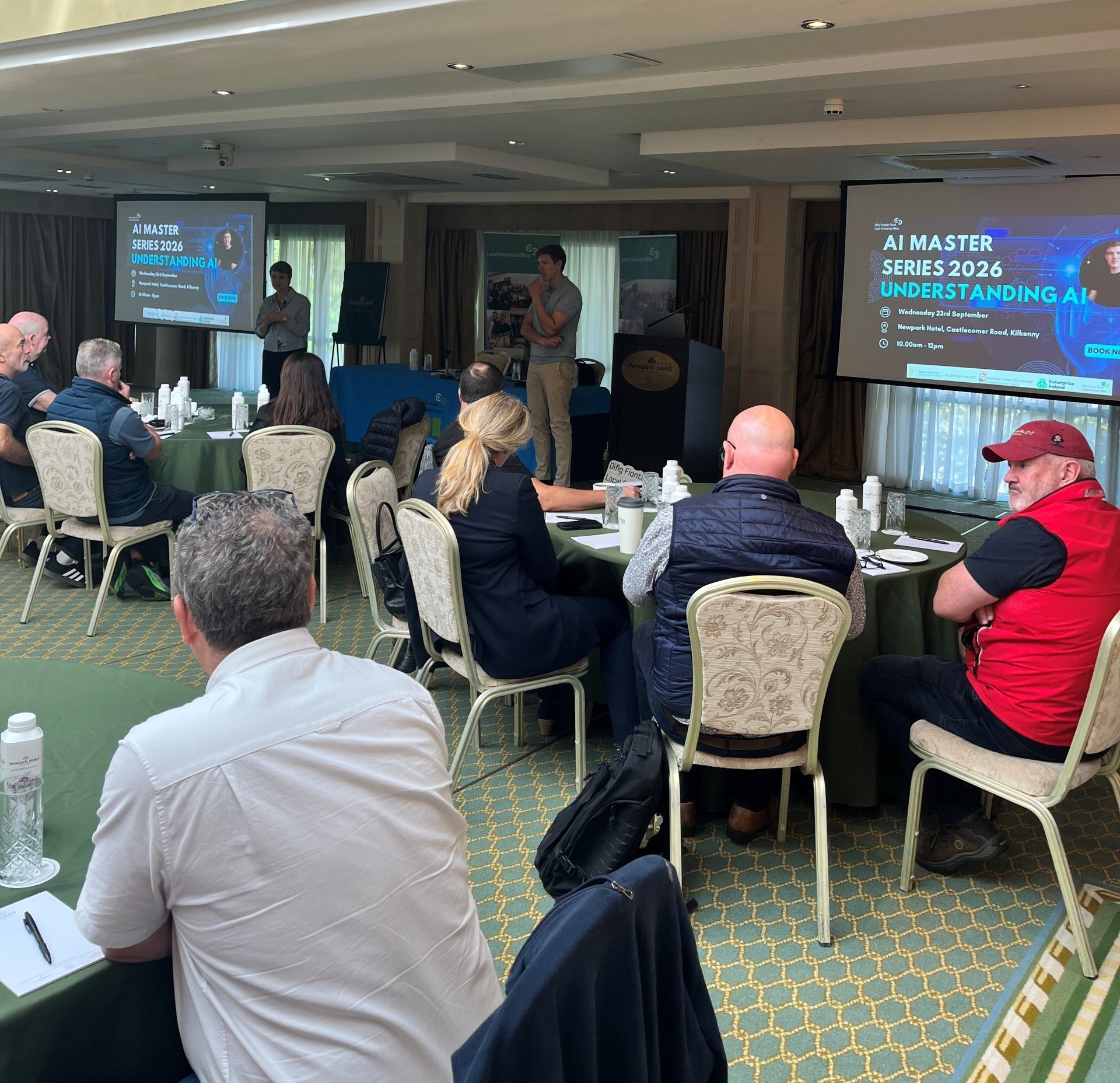
My work with SME audiences includes speaking at the ISME Roadshow. The perspective I bring combines those business conversations with AI Awards examples and practitioner interviews.
For a chamber event, industry association or company leadership session, I can help your audience examine where AI could be useful, what needs to be in place and how to judge the result.
Share This Story, Choose Your Platform!
Planning an event or leadership offsite?
Mark Kelly delivers evidence-based AI keynotes and hands-on AI leadership workshops for boards, executive teams and conferences across Ireland and Europe.