A useful AI keynote starts with understanding the room.
Who will attend? What work do they do? Which tools can they access? What should they be better equipped to do afterwards?
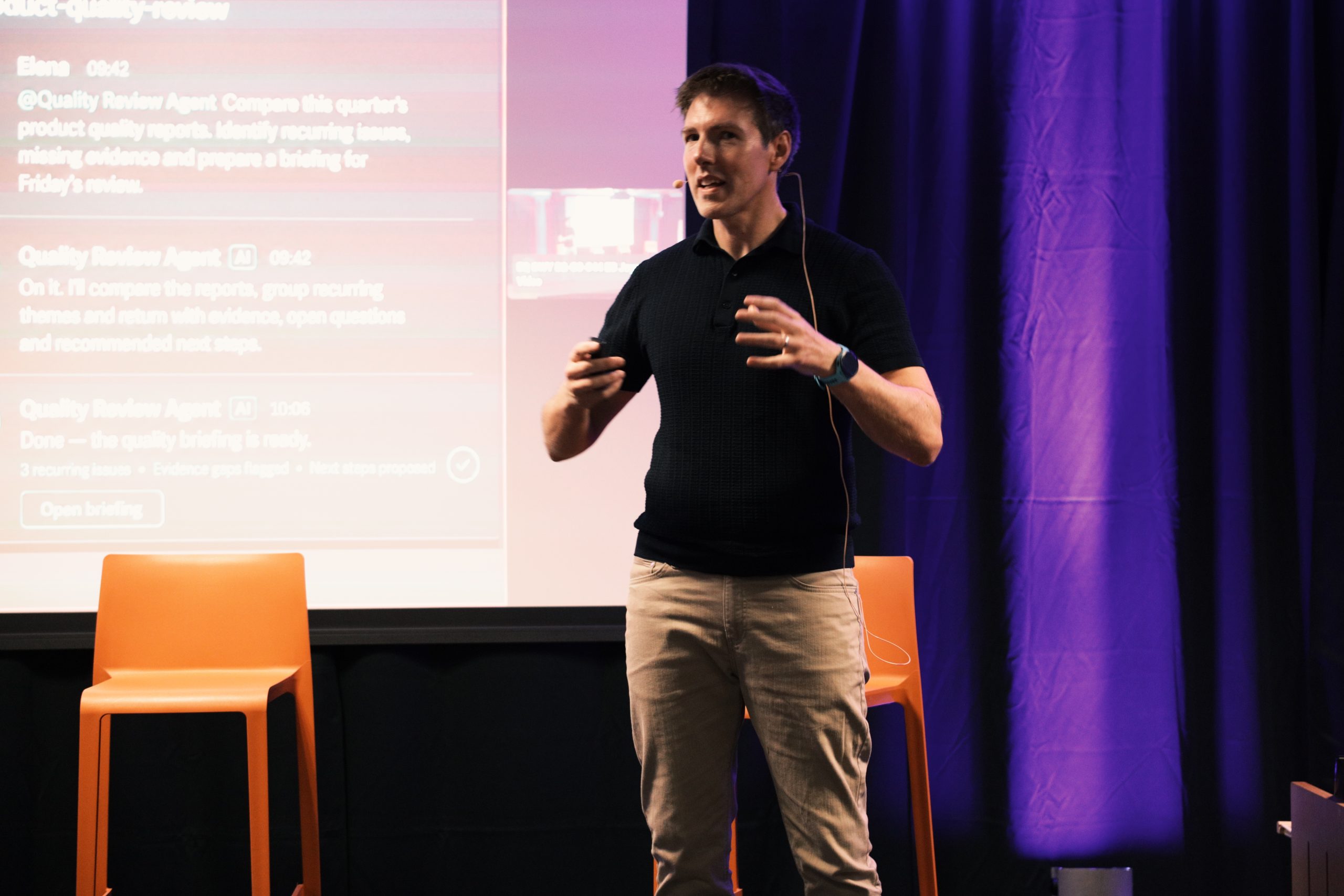
My September 2026 keynote for Medtronic brought those questions into focus. The audience included engineers, project and programme managers, technical professionals and people leaders. There were different Copilot licences and clear boundaries around data and responsible use.
I worked with Medtronic’s Technical Training and Professional Development team to shape the session. The demonstrations were pre-recorded and narrated live, allowing us to compare different approaches in a controlled way. Read the Medtronic case study
For event organisers, the lesson is that preparation should change the substance of the session.
Start with the work people recognise
An audience should be able to connect an example with a decision or task in its own working day.
For a technical team, that might mean examining assumptions in an explanation. For managers, it could involve preparing a brief or comparing options. For customer-facing staff, it might mean checking whether a proposed response is accurate and useful.
These are possible applications to discuss, not a claim that every task is suitable for AI.
Before selecting a demonstration, I would ask:
- Does the audience recognise the problem?
- Can they use the approach within their approved environment?
- What information would they need?
- What must a person check?
- What would make the result useful?
A demonstration earns its place when it helps answer those questions.
Teach habits people can reuse
The Medtronic session focused on three habits: provide relevant context, examine the tool’s assumptions and preserve your own voice. It also introduced a reusable one-page Context Brief. Session approach
Those habits provide a useful starting point beyond any individual tool.
For example, consider an illustrative request to prepare a project update.
“Write an update” leaves the system to fill in too many gaps.
A better brief would explain the audience, purpose, confirmed facts, unresolved questions and required format. It would also identify information that must not be inferred.
After receiving the draft, the user should check whether it accurately represents the project. Did it turn a possibility into a commitment? Did it conceal uncertainty? Did it invent progress?
The skill is in briefing and reviewing the work.
Bring external examples into the room carefully
My work through AI Ireland and the AI Awards gives me a wider set of examples to draw on when preparing sessions.
Among the 2026 finalists, Laya Healthcare’s Knowledge Hub supports advisers with referenced information. The Mental Health Commission describes AI-assisted report drafting with expert validation. AI Awards 2026 finalists
These examples raise useful questions for another organisation:
What information supports the answer? Who checks it? Where does professional judgement remain essential?
They are examples I can use in future leadership discussions. I am not suggesting they were presented during the Medtronic keynote or that Medtronic uses those systems.
Their value lies in making the discussion specific. A published project description is a starting point for examination, rather than proof that another organisation will achieve the same result.
Connect capability with judgement
The AI Ireland Podcast adds another perspective.
In my conversation with Disseqt AI’s Cyril Treacy, we explored governance, assurance and the role of testing in understanding system behaviour. Listen to the podcast discussion
For keynote preparation, my takeaway is to show the checking as clearly as the capability.
If a demonstration produces an impressive answer, pause to examine it.
What is supported? What is uncertain? What would need verification before someone acted?
That gives the audience a way to evaluate what they have seen. It also makes room for a useful discussion about where AI assistance belongs in their own work.
Be precise about what client feedback demonstrates
Ellie Stoskopf, IT Project Lead at Medtronic, described the team as:
“inspired and empowered to explore new ways of working.”
That feedback supports the session’s relevance and reception. It does not establish a measured productivity increase or a lasting change in behaviour. Full client feedback
Those later outcomes require follow-through.
An organisation could ask participants which approach they tried, what helped and what problems they encountered. A selected workflow could then become a controlled pilot with a baseline and review date.
My guide to measuring AI value explains how to make that next step practical.
Decide what should happen after the keynote
A keynote can give people a shared understanding and a useful set of questions.
A workshop provides more time to apply those questions to a process, compare priorities and agree actions.
Before booking, decide which outcome matters most.
If the purpose is to help a conference audience understand AI’s relevance, a keynote may fit. If a leadership team needs to leave with an agreed pilot and named owners, allow time for participation and decision-making.
Preparation can include a leadership readiness survey to identify experience, concerns and priorities. The findings can help shape the session rather than assuming everyone starts from the same place.
Planning an AI session for your organisation?
Tell me who will be in the room, what they are trying to achieve and the boundaries they work within.
I bring together client delivery experience, AI Awards examples, practitioner conversations and leadership research to make the discussion relevant to your organisation.
Explore my AI keynote speaking, review the Medtronic case study, or discuss your event and check availability.
Share This Story, Choose Your Platform!
Planning an event or leadership offsite?
Mark Kelly delivers evidence-based AI keynotes and hands-on AI leadership workshops for boards, executive teams and conferences across Ireland and Europe.