From Pilots to Production: How to Scale AI in 2026
The AI race is no longer about who has a pilot. It is about who can industrialise one.
That is the real story of enterprise AI this year. The proof is hard to ignore. MIT research found that 95% of AI pilots deliver zero measurable impact on profit and loss. The technology works. The scaling does not.
I have reviewed more than 1,000 real AI projects through the AI Awards and trained more than 10,000 professionals. I know what gets a pilot to production, and what leaves it stuck. This post explains the gap, why it happens, and what leaders can do about it.
The pilot-to-production gap is the real story of 2026
For years, companies ran pilots to answer one question: can this work? For most use cases, that question is now settled. The new question is harder. Can we run this safely, at scale, across the business?
Most organisations cannot. The numbers are blunt:
- IDC research found 88% of AI pilots never reach production. The failures cluster on governance, data, and oversight, not on the model.
- Deloitte’s State of AI in the Enterprise 2026 report found only 25% of organisations have moved 40% or more of their pilots into production.
- In the same Deloitte survey, 74% of organisations want AI to grow revenue. Only 20% have seen it happen.
Here is what that means for a budget-holder. Most of the money spent on AI so far has bought experiments, not results. Boards have noticed. The question in the room has shifted from “how much are we spending on AI?” to “what are we getting back?”
Why most pilots never grow up
A pilot is built for a controlled win. Clean data. One narrow task. A small, friendly group of users. Production is the opposite. Real data, real volume, real users, and real consequences.
Pilots stall for reasons that have little to do with the model. The common blockers are:
- Data readiness. Pilot data is tidy. Production data is spread across CRM, finance systems, and old platforms that do not talk to each other.
- Governance. Once AI touches customers or money, you need clear rules on who owns it, who signs off the risk, and where the data sits.
- Workflow integration. Many teams bolt AI onto an old process instead of redesigning the work. The tool changes, the bottleneck does not.
- Measurement. Most pilots launch with no agreed definition of success. So even a working pilot cannot prove it worked.
This is the part leaders underestimate. Roughly 80% of the work to move from pilot to production is data engineering, governance, workflow integration, and measurement. The model is the easy 20%. The plumbing is the hard 80%.
What industrialising AI actually looks like
Industrialising AI means treating it as a business capability, not a science project. The mindset changes. The work changes. The way you judge success changes.
A simple way to see the shift:
| Pilot | Production | |
|---|---|---|
| Question | Can it work? | Can we run it at scale, safely? |
| Owner | A curious team | A named business owner |
| Success | A neat demo | A measured outcome against a baseline |
Think of it like a restaurant. A pilot is a test kitchen. You try a dish, taste it, and adjust. Production is service on a busy Saturday night, with real customers, real orders, and a kitchen that has to deliver every time. Plenty of great test-kitchen dishes never make it onto the menu. The recipe was fine. The kitchen was not ready.
The shift is already visible in where AI value comes from. Gartner expects more than 70% of enterprise AI value by 2026 to come from AI built into real workflows, not from standalone tools sitting to the side. Value shows up only when AI changes a real decision or a real action.
What this means for leaders
You do not industrialise AI by buying a better model. You do it by changing how the work runs. These are the steps I walk leaders through.
- Pick one workflow. Choose a high-volume task with a clear, measurable outcome. Customer service, document handling, and sales support are good starting points. Why it matters: one clear win builds the case for the next.
- Set a baseline. Measure how the work performs today, before AI. Why it matters: with no baseline, you can never prove the AI helped.
- Redesign the work. Do not bolt AI onto the old process. Rebuild the flow around it. Why it matters: this is where most of the value, and most of the risk, lives.
- Measure in real time. Track cost, speed, and quality against your baseline as you go. Why it matters: boards now want proof, not usage stats.
- Then scale. Expand to the next team once the first win is proven. Why it matters: incremental growth beats a big-bang rollout that no one can govern.
This matters even more as AI starts to act on its own. Deloitte reports that agentic AI use is expected to rise from 23% to 74% of enterprises within two years, yet only 21% have mature governance for it. Agents do not wait for a prompt. They take action. Without governance, that is a risk, not a result. My SEE Loop framework (Spot, Experiment, Embed) is built to close that gap in a structured way.
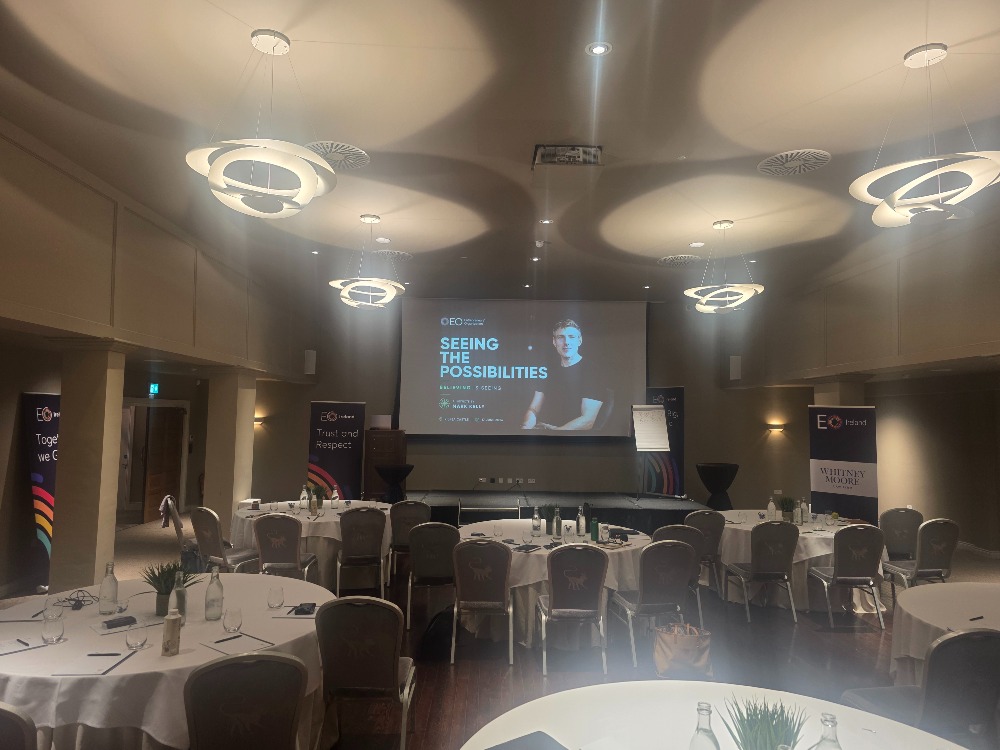
Booking an AI keynote speaker for 2026? Make industrialisation the theme
If you are booking an AI keynote speaker for 2026, this is the conversation your audience needs. Not “what is generative AI?” That talk is two years out of date. The room has moved on.
Boards and senior teams want two things. They want honesty about what is not working, backed by real numbers. And they want a clear path to doing better. The danger is the futurist with confident predictions but no operating experience. To a board, that reads as theatre, not insight.
This is where operator credibility counts. I run an AI staffing firm and a national AI awards programme. I have seen what 1,000+ real projects get right and wrong. I bring that to the stage through the 5 P’s of AI Readiness framework: People, Process, Platforms, Proprietary Data, and Products and Services. It gives leaders a practical map from hype to habit, not just a set of slides.
The themes that land in 2026 are clear: the pilot-to-production gap, agentic AI and its real costs, shadow AI and governance, and how to measure AI value in a way a board will accept.
FAQs
What is the pilot-to-production gap in AI?
It is the gap between an AI project that works in a test and one that runs across the business every day. Many pilots perform well in a controlled setting, then stall when faced with real data, real users, and real governance. Research suggests most pilots never close this gap.
Why do most AI pilots fail to reach production?
Not because of the model. They fail on the foundations: messy data, no governance, weak workflow integration, and no agreed measure of success. Studies put the share of pilots that never reach production as high as 88%, with the causes sitting in process and data rather than technology.
What does it mean to industrialise AI?
It means running AI as a reliable business capability, not a one-off experiment. That includes clean and governed data, AI built into real workflows, clear ownership of risk, and measurable outcomes tracked against a baseline.
What should an AI keynote cover in 2026?
The topics that matter to boards: moving from pilots to production, agentic AI and governance, the future of work, and how to measure AI return. The best sessions are grounded in real cases and give leaders something they can act on the next week, not just inspiration.
How do leaders measure AI ROI?
Start with one workflow and one baseline. Track cost per task, cycle time, quality, and revenue effect against that baseline for at least a quarter. Avoid vanity metrics like seat counts and login numbers. They are easy to collect and tell you nothing about value.
The bottom line
The next wave of AI value will come from execution, not experiments. The winners will not be the ones with the most impressive pilot. They will be the ones who can industrialise AI at scale, safely, and prove the return.
If you want a keynote that helps your leaders make that shift, get in touch to discuss your 2026 event.
Mark Kelly is an AI keynote speaker and the Founder of AI Ireland. He has delivered 300+ keynotes for organisations including Microsoft, Oracle, Salesforce, and PwC, trained more than 10,000 professionals, and reviewed more than 1,000 real AI projects through the AI Awards.
Share This Story, Choose Your Platform!
Planning an event or leadership offsite?
Mark Kelly delivers evidence-based AI keynotes and hands-on AI leadership workshops for boards, executive teams and conferences across Ireland and Europe.