AI Is Not Taking Your Job. It Is Taking Your Tasks.
AI is not coming for your job title. It is coming for the tasks inside it. Jobs are just bundles of tasks. When enough tasks move, the job description changes. Then the team changes. Then the org chart changes. That is happening right now, and most leaders are watching the wrong number.
The question I get in every room
I show one chart in almost every session I run. As an AI keynote speaker I have watched leaders react to it hundreds of times, and the reaction is nearly always the same. A small gasp. Then quiet. Then a hand goes up.
“If AI is better than us at all of that, why is it not doing my job?”
And the sharper version, usually from the CFO at the back: “Why isn’t AI running our company?”
Fair questions. Here is the honest answer.
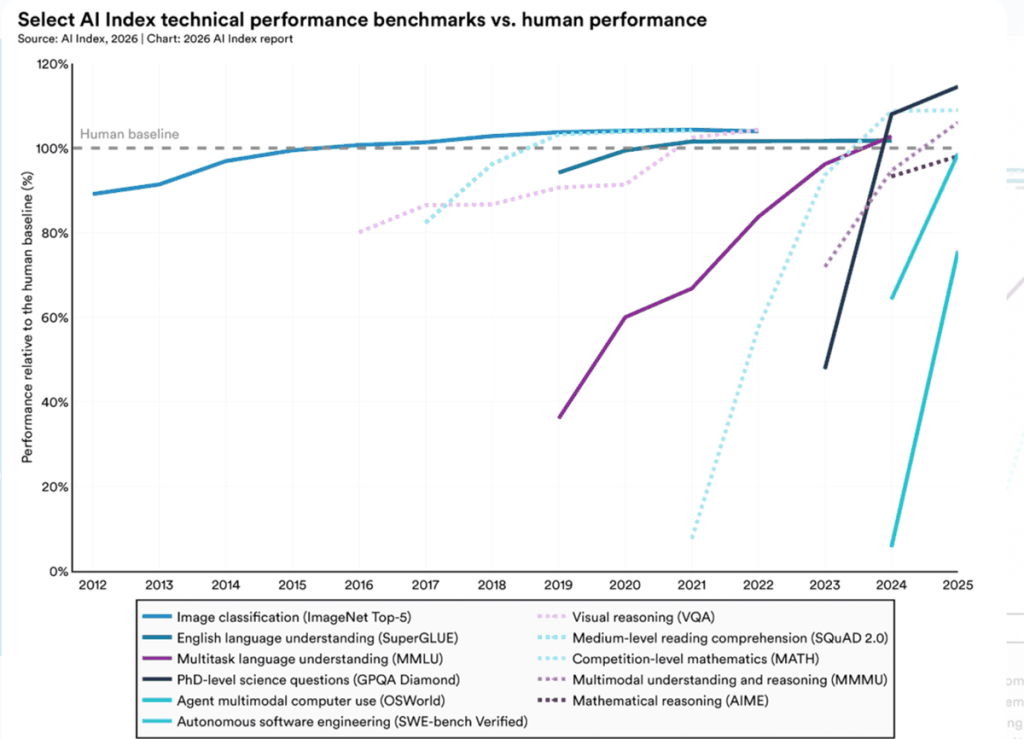
Select AI Index technical performance benchmarks vs. human performance. Source: AI Index, 2026.
Image alt text: Stanford AI Index 2026 chart of AI benchmark performance against the human baseline, used by AI keynote speaker Mark Kelly.
What the 2026 data actually says
The chart comes from the Stanford AI Index 2026, published in April. It tracks AI performance against a human baseline across benchmarks like image classification, reading comprehension, competition maths and PhD-level science.
Most of those lines have crossed the human line. Frontier models now meet or exceed human baselines on PhD-level science questions, multimodal reasoning and competition mathematics.
Two are still below it, and both matter more than the rest.
- Agent computer use. On OSWorld, which tests agents on computer tasks across operating systems, accuracy rose from roughly 12% to 66.3%, within 6 percentage points of human performance.
- Autonomous software engineering. On SWE-bench Verified, performance rose from 60% to near 100% in a single year.
Now the part almost nobody says out loud, and the reason I keep this slide honest. That 60 to 100 figure is measured against a scaled human baseline, not the raw share of problems solved. One analysis of the number points out that by OpenAI’s own accounting in February 2026, the best raw solve rate moved from 74.9% to 80.9% over the preceding six months.
Real progress. Not “AI has solved coding.”
If you present this chart to your board, know that difference. It will save you from the one question you cannot answer.
The answer: tasks are not jobs
Here it is in eight words.
AI is eliminating tasks. Tasks make up jobs.
A benchmark measures a task. Your job is forty tasks in a trench coat. Some of them a model can now do better than you. Some of them need a corridor conversation, a judgement call, or someone willing to put their name on a decision.
So AI does not walk in and take a job. It hollows out a job from the inside. And then a human decides what is left.
That last sentence is the whole thing. AI is not taking your job. It is taking pieces of it, and someone else is deciding what remains.
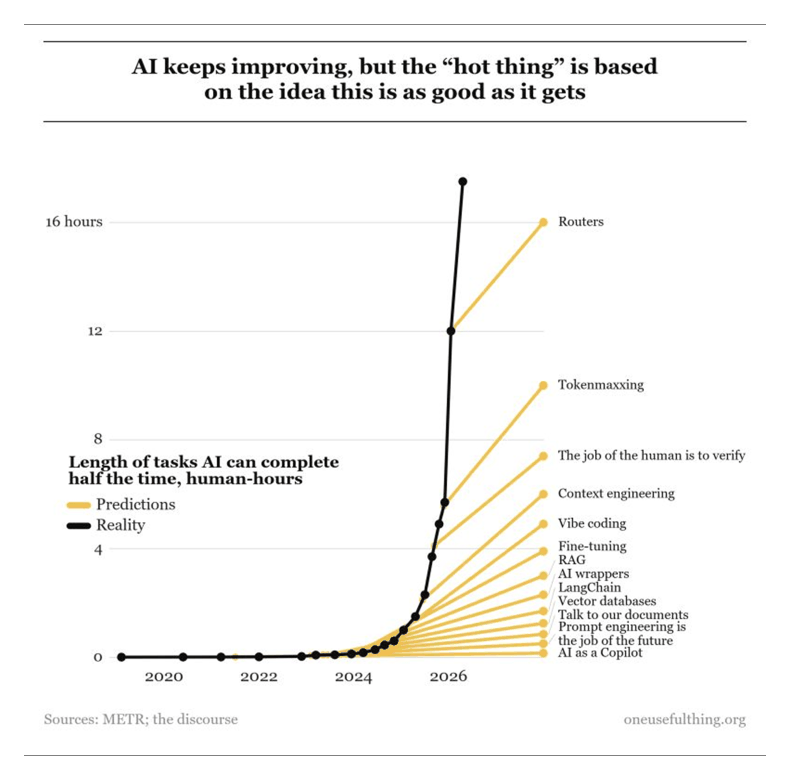
Length of tasks AI can complete half the time, in human-hours. Chart by Ethan Mollick, One Useful Thing, using METR data.
What this looks like inside a real company
Amazon is the example everyone reaches for, so let us use the accurate version rather than the dramatic one.
Andy Jassy said efficiency gains from AI would likely cause Amazon’s corporate head count to fall, and that the company would need fewer people doing some of the jobs being done today, and more people doing other types of jobs. (CNBC)
Read that twice. It is not “AI replaces humans.” It is task redistribution announced in advance.
Worth knowing the caveat, because a sharp CFO will raise it: Jassy has separately said the cuts were driven by management layers and bureaucracy, not by AI alone. Do not use Amazon’s layoff numbers as proof of AI displacement. Use his sentence instead. The sentence is the evidence.
The sequence inside most organisations runs like this:
- Tasks shift to AI.
- Job descriptions stop matching reality.
- Descriptions get rewritten around the human work that is left.
- People are trained into the new shape of the role.
- People who cannot get there in time are let go.
- People are hired who already have the skills.
Skills become the whole conversation. Not titles.
The part that should worry you
Here is where I have had to update what I say on stage.
At an aggregate level, there is no jobs shock. Anthropic’s head of economics, Peter McCrory, set this out in July 2026. Unemployment stood at 4.2% in June, job openings roughly matched the number of unemployed, and prime-age employment sat near multi-decade highs. Updated Bureau of Labor Statistics analysis showed no relative deterioration among workers whose jobs contain a large share of tasks AI is used to automate.
That sounds like good news. It is not the whole picture.
The damage is real. It is just concentrated at the bottom rung. Stanford finds a 13 to 16% relative fall in employment for 22 to 25 year olds in exposed occupations, and the UK government finds exposed job adverts down 38%. (Futurum) Global entry-level job postings have fallen 29% since January 2024.
Picture the 23 year old who would have been your junior analyst. The tasks that used to be her first year are now a prompt. Nobody made her redundant. The role was simply never posted.
Meanwhile the top of the house is fine, and Dario Amodei has softened his own forecast. In May 2026 he described AI as a productivity multiplier rather than purely a replacement for workers, pointing to the Jevons paradox.
So: no aggregate shock, real damage at the entry rung. Both true at once.
The counter-argument, before you make it
The strongest attack on everything I have just written is this: AI is taking jobs, quietly, through hiring that never happens rather than firing that does.
A door closing for new entrants does not register as displacement the way a layoff does, which is exactly why it is easy to miss and dangerous to ignore.
I think that is right, and it is why “tasks are not jobs” should not make you relax. The ladder is still there. Somebody removed the first rung.
If your workforce plan assumes juniors will arrive, learn on routine work, and grow into seniors, that plan has a hole in it. That is a board-level problem, not an HR one.
What to do on Monday
Three steps. None of them need a budget.
Step 1: Run a task audit
List every task you personally did last week. Not projects. Tasks. Aim for 30 to 40 lines.
Then mark each one:
- A if AI could do it now
- B if AI could do it with your input
- C if it needs a human in the room
Count your Cs. That is your actual job in 2026. Do the same exercise with your leadership team and you have the beginnings of a workforce plan.
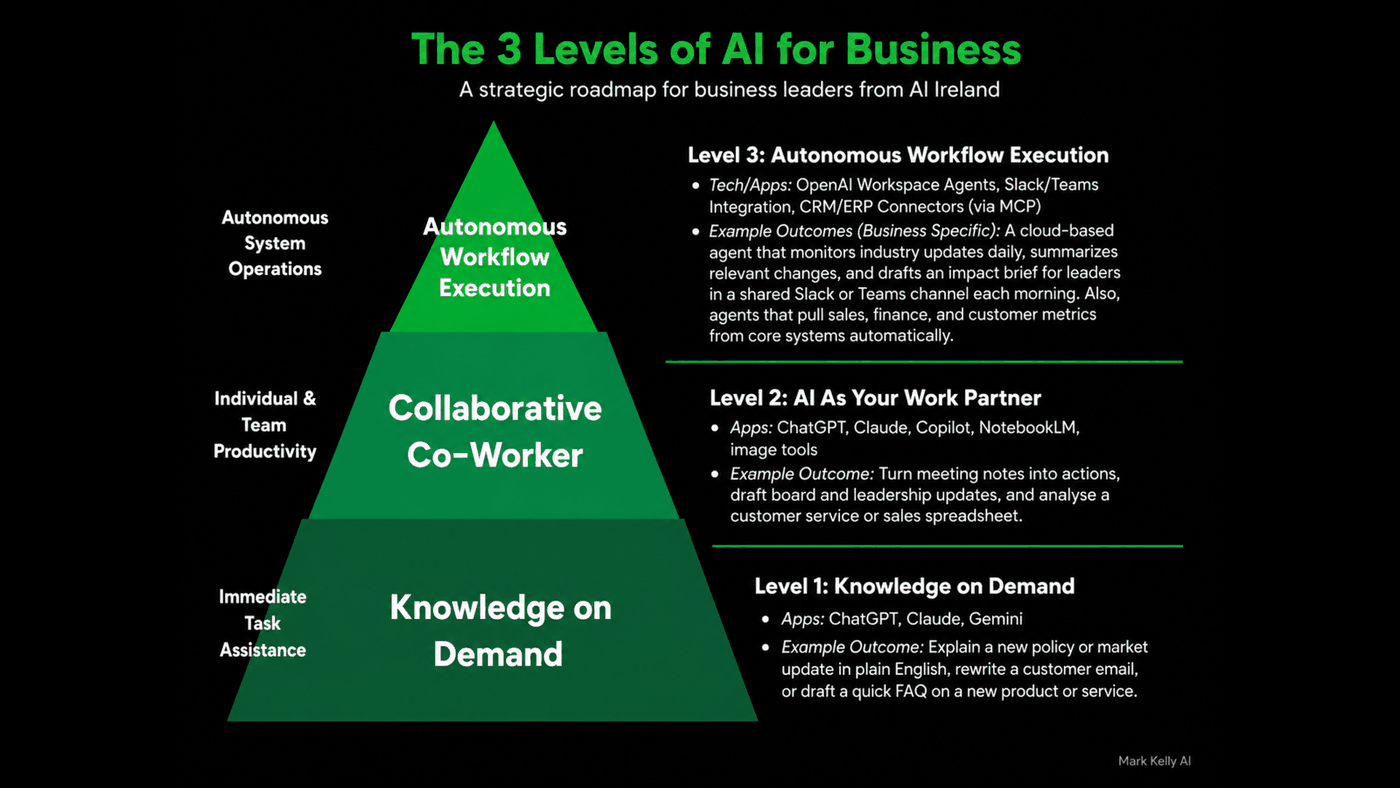
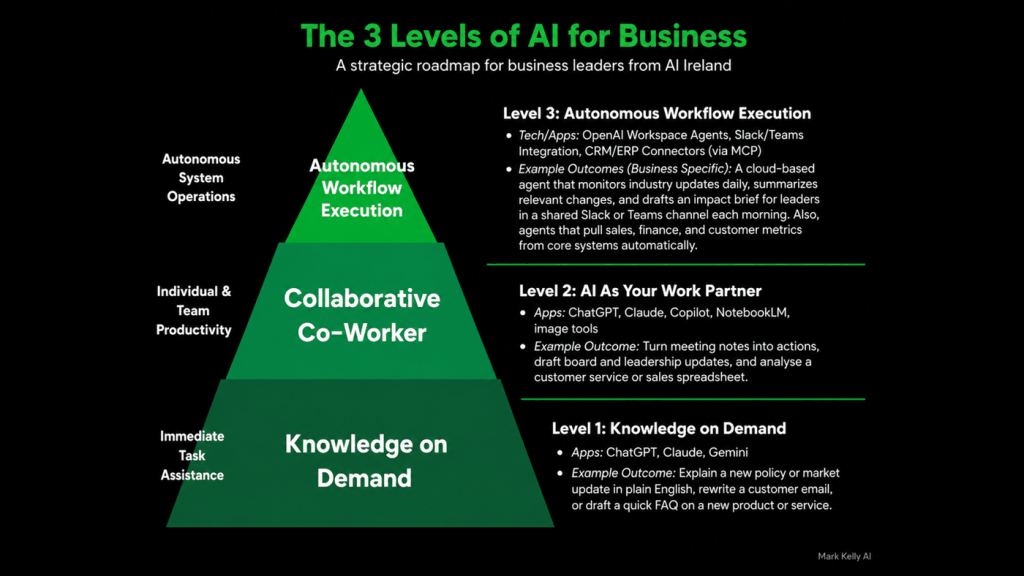
Step 2: Place your team on the 3 Levels
This is the model I use in executive AI workshops. Three levels, in order.
| Level | What it is | What it looks like |
|---|---|---|
| 1. Knowledge on Demand | Immediate task help | Explain a policy in plain English, redraft a customer email |
| 2. Collaborative Co-Worker | Individual and team productivity | Turn meeting notes into actions, analyse a sales spreadsheet |
| 3. Autonomous Workflow Execution | System operations | An agent that monitors industry updates daily and drafts a brief for leaders each morning |
Most organisations think they are at Level 3. Most are stuck at Level 1 with a Level 3 slide deck. Be honest about where you actually sit, because you cannot skip a level.
Image alt text: The 3 Levels of AI for Business pyramid from AI Ireland, a roadmap used in executive AI workshops.
Step 3: Solve one personal problem with AI
This is the fastest way to build real skill, and it costs nothing.
I am 44. I have a health project running with my own knee MRI files, my recent bloods, my DEXA scan and my running data. I asked it whether I should run a marathon or do Hyrox. It told me no, because of my left knee, and gave me a strengthening plan instead. I photographed a pair of runners and asked whether the support would help. I got a better recommendation back, based on my own data.
People do this every day now. A photo of a bike and “help me fix this.” A photo of the fridge and “what’s for dinner?” More than 1 billion people now use standalone AI tools every month.
The method transfers directly to work:
- Pick a real problem you care about.
- Load real data, not a toy example.
- Ask a decision question, not a general one.
- Act on the answer and see if it was right.
Curiosity beats certainty here. Call it a growth mindset if you like. What matters is being willing to be bad at something in public for a fortnight.
And the market is already paying for it. AI skills now appear in about 2.5% of all US job postings, up 55% year on year, with agentic-AI skill mentions growing more than 280% in a single year. Every client I work with who is hiring says the same thing: given two equal candidates, they take the one with AI literacy and a personal project.
FAQ
Is AI taking jobs in 2026? Not at an aggregate level. Unemployment is near full employment and prime-age employment is near multi-decade highs. But entry-level hiring in exposed occupations has fallen sharply, so the effect is real and concentrated among young workers.
What is the difference between a task and a job? A task is one unit of work, like drafting a summary. A job is a bundle of tasks plus responsibility and judgement. AI is very good at individual tasks and weak at owning outcomes, which is why jobs are being rebuilt rather than removed.
Which jobs are most exposed to AI? Roles where output is easy to verify and the context sits in one place. Software, customer support and routine analysis are furthest along. Work needing physical presence, trust or accountability is least exposed.
How should a CEO prepare for AI’s impact on the workforce? Start with a task audit at leadership level, be honest about which of the 3 Levels your organisation actually operates at, and fix your junior talent pipeline before the missing rung becomes a missing generation of managers.
I run keynotes and workshops on exactly this, using evidence from over 1,000 AI projects reviewed and 10,000+ professionals trained. If your org chart no longer matches how the work actually gets done, book a conversation about bringing an AI keynote speaker or a hands-on session to your leadership team.
Share This Story, Choose Your Platform!
Planning an event or leadership offsite?
Mark Kelly delivers evidence-based AI keynotes and hands-on AI leadership workshops for boards, executive teams and conferences across Ireland and Europe.