AI Readiness Starts With Ready People
You can spend a fortune on AI and still see nothing change. The reason is almost always the same. The people are not ready. AI readiness starts with people, not tools. It comes down to whether your team has the skills, the confidence, and the time to use AI well. People is the first part of my 5 P’s framework, and it is the one most leaders skip. This post shows you the signs your team is not ready, how to build real confidence, and how to lead the way yourself.
You can buy the best AI tool on the market and still see nothing change.
The reason is almost always the same. The people are not ready.
People is the first part of my AI readiness framework, and it is the one most leaders skip.
This post shows you how to get it right.
Why people come first
AI is a tool. Tools need skilled hands. If your team cannot use it, or will not, the spend is wasted. This is consistent with broader research showing that AI value depends heavily on human capability and adoption.
A team I worked with bought licences for an AI assistant and waited for results. Six months later, almost no one had logged in. The tool was fine. The rollout forgot the people.
Signs your team is not ready
- Only a few keen staff use AI. Everyone else watches.
- People fear AI will take their job, so they avoid it.
- Staff do not know what is allowed and what is not.
- There is no time set aside to learn.
If two or more of these sound familiar, fix People before you buy anything else.
How to build AI confidence
- Name a clear reason. Tell people what AI will solve for them, not just for the business.
- Train in small groups on real tasks they do every week.
- Set simple rules. What is safe to put into AI tools, and what is not.
- Give people time. One hour a week to practise beats a single big workshop.
- Share wins. When someone saves time, tell the whole team.
The leader’s role
Your team copies what you do, not what you say. If leaders use AI in the open, fear drops fast.
Talk about your own mistakes with it. Ask staff what they have tried. Set the tone.
Score yourself: Level 0 to 4
Use the maturity scale from the framework to see where you stand on this P today.
Most teams start between Level 1 and Level 2.
| Level | What it looks like |
|---|---|
| Level 0 | No one uses AI. There is no plan. |
| Level 1 | A few people try AI on their own. |
| Level 2 | Several use it on real tasks, but there are no shared rules. |
| Level 3 | Most of the team is trained and clear rules are in place. |
| Level 4 | AI use is second nature. People coach each other. |
Common questions
Do my staff need a technical background to use AI? No. Most business AI tools need plain language, not code.
How long does it take to build AI confidence? Small, steady practice over a few weeks beats one big session.
What is the biggest blocker? Fear. People worry about their jobs. Name it early and deal with it openly.
Related guides
- The 5 P’s of AI Readiness (main framework)
- How to spot the right processes for AI
- The AI tools you already own
Run this with your team
You do not need more AI tools. You need a clear plan.
I run the 5 P’s with leadership teams, and People is where the work begins to show.
Book your workshop
Mark Kelly is an AI keynote speaker and workshop leader and the Founder of AI Ireland. He has trained more than 10,000 professionals and delivered AI sessions for Microsoft, Abbvie, Zendesk, and PwC.
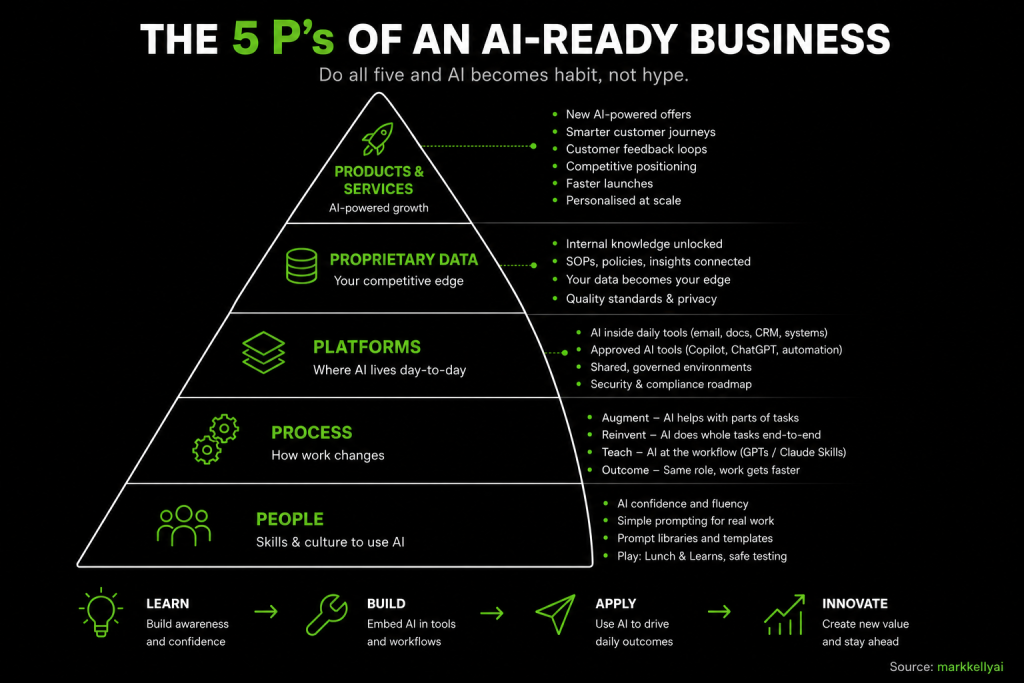
The 5P Framework
The 5P’s of an AI-Ready Business.
Share This Story, Choose Your Platform!
Planning an event or leadership offsite?
Mark Kelly delivers evidence-based AI keynotes and hands-on AI leadership workshops for boards, executive teams and conferences across Ireland and Europe.