By Mark Kelly | Founder of AI Ireland & the AI Awards | AI Keynote Speaker & Advisor
Ireland is already applying AI. The opportunity now is to scale what works.
Yesterday, I attended the International AI Summit at the RDS in Dublin, alongside approximately 1,500 business leaders, policymakers, researchers and entrepreneurs.
The summit brought together some of the world’s most influential voices in artificial intelligence, including Demis Hassabis from Google DeepMind, Brad Smith from Microsoft and Sarah Friar from OpenAI.
The conversations ranged from groundbreaking advances in healthcare and the rise of AI agents to responsible innovation, European competitiveness and the future of work.
Having spent the past eight years working closely with Ireland’s AI community, interviewing hundreds of AI leaders and reviewing applications through the AI Awards, I found the discussions particularly interesting.
Because one thing is already clear to me.
Ireland does not lack AI innovation. We have plenty of evidence that organisations are putting AI to work.
The challenge now is helping more businesses turn individual successes into measurable, organisation-wide improvements.
Here are my ten biggest takeaways from the summit and what they mean for business leaders.
1. Ireland Is Already Applying AI. Now We Need to Scale It.
The Taoiseach opened the summit by welcoming delegates to Dublin and outlining Ireland’s ambition to become a leading location for AI innovation and adoption.
One of the most important announcements was the launch of Intelligence, a national programme focused on accelerating AI adoption across businesses and public services.
The programme includes initiatives supporting AI skills, research, entrepreneurship and responsible adoption.
I welcome this development.
Through my work with the AI Awards, I see remarkable examples of organisations already applying artificial intelligence to real-world problems.
We have companies using AI to improve healthcare, streamline operations, support customers and create entirely new products.
The opportunity is not to convince Ireland that AI matters.
It is to help more organisations adopt it successfully.
For CEOs and leadership teams, that means moving beyond the question of which AI tools employees should use.
The more important question is:
Which parts of our business could we fundamentally improve using AI?
That is where the real value begins.
2. Sarah Friar: AI Agents Are Changing How Work Gets Done
One of the most interesting contributions came from Sarah Friar, Chief Financial Officer at OpenAI.
She highlighted research showing how quickly businesses across Europe are moving towards AI agents.
This represents an important shift.
For the past few years, many people have used AI primarily to ask questions, generate content or summarise information.
AI agents can go further.
They can carry out sequences of tasks, work with approved business systems and support more complete workflows.
Think of the difference between asking an assistant to draft a customer email and asking it to prepare a complete customer meeting briefing.
An AI agent could potentially gather relevant information, prepare an agenda, identify outstanding actions and draft a follow-up.
The employee remains responsible for reviewing the information and approving important decisions.
But much of the repetitive preparation could be completed automatically.
Research shared by OpenAI suggested that agentic tools now account for more than half of AI output among the European business customers studied.
The research also highlighted differences between European countries, including particularly strong agent usage among some enterprise customers in Lithuania.
My takeaway was straightforward.
We are moving from asking AI questions to giving AI work to do.
For business leaders, this changes the conversation.
Rather than asking how employees can write better prompts, we should start identifying workflows where AI can complete meaningful tasks.
That could involve customer onboarding, financial reporting, recruitment administration, procurement or operational planning.
The opportunity is significant, but it requires clear ownership, appropriate permissions and human oversight.
3. Demis Hassabis: AI Could Transform Healthcare
Demis Hassabis, CEO and co-founder of Google DeepMind and Nobel Prize winner, delivered one of the most fascinating sessions of the day.
He discussed the journey from AlphaGo, the AI system that defeated world champion Lee Sedol at Go, to AlphaFold, which has transformed the prediction of protein structures.
Why does this matter?
Proteins are fundamental to how our bodies function.
Understanding their structures is important for studying diseases and developing new treatments.
Historically, determining these structures could require substantial time and scientific effort.
AlphaFold has helped researchers accelerate this work dramatically.
For me, this is one of the most compelling examples of what AI can achieve.
We often discuss artificial intelligence in terms of saving employees time or increasing productivity.
Those benefits matter.
But AI also has the potential to help solve some of humanity’s most difficult challenges.
Healthcare is one obvious example.
The same principle applies to energy, sustainability, manufacturing and scientific research.
AI’s greatest value may come from solving problems we previously believed were too difficult to solve.
Hassabis also raised an important concern about safety.
As AI systems become more powerful, we need more scientific and mathematical expertise focused on ensuring they remain reliable, secure and aligned with human intentions.
Innovation cannot come at the expense of trust.
4. Brad Smith: AI Governance Must Become Practical
Brad Smith, Vice Chair and President of Microsoft, spoke about the importance of responsible AI development and ensuring its benefits are shared across society.
His message about governance particularly resonated with me.
In my work with leadership teams, I frequently see two extremes.
Some organisations are enthusiastic about AI but have limited rules governing its use.
Others are so concerned about potential risks that they struggle to move beyond experimentation.
Neither approach is ideal.
Good governance should make responsible AI adoption easier, not harder.
Businesses need straightforward answers to important questions.
Who is responsible for an AI system?
What information can it access?
Which actions can it take independently?
Who approves important decisions?
How do we identify and correct mistakes?
These questions become even more important as organisations introduce AI agents.
For example, an AI system might identify an unusual financial transaction.
But that does not necessarily mean it should have permission to approve or reject the transaction.
The appropriate human decision-maker must remain accountable.
My view is that every organisation needs clear rules that employees can understand and apply.
Responsible AI should be part of everyday business operations, not simply a document sitting on a shared drive.
5. The Future of Work Is About People, Not Just Technology
Another important announcement was the establishment of a forum bringing together Government, employers and trade unions to examine the impact of AI on employment and the workplace.
This is an important development.
AI is already changing the activities people carry out every day.
Employees can use AI to analyse information, prepare reports, summarise meetings, create presentations and automate repetitive administration.
As AI becomes more capable, the nature of many roles will continue to evolve.
But I believe the conversation needs to go beyond predictions about jobs disappearing.
Business leaders should be asking how AI can help their employees become more effective.
What repetitive work could we remove?
Which decisions could we improve?
How can we give employees more time to focus on customers, creativity and problem-solving?
These are practical questions.
When I deliver AI leadership workshops, I often encourage people to identify tasks that consume time but add limited value.
That might be preparing meeting notes, consolidating spreadsheets or searching across documents.
Once employees experience how AI can help with these activities, the conversation changes.
AI becomes less abstract.
People start to see how it can improve their working day.
The organisations that succeed will invest in their people as seriously as they invest in their technology.
6. Europe Must Make It Easier for AI Companies to Scale
A recurring theme throughout the summit was Europe’s competitiveness.
We heard from entrepreneurs about the challenges of building and scaling businesses across European markets.
Europe has world-class research institutions, talented entrepreneurs and significant industrial expertise.
However, fragmentation can make it difficult for companies to grow across borders.
Different national systems, market requirements and barriers to accessing data can create additional complexity.
One discussion that stood out concerned industrial data.
Europe has considerable strengths in manufacturing, pharmaceuticals, engineering and other industries.
These businesses generate valuable operational information.
When used appropriately, that information can help AI systems identify inefficiencies, improve maintenance, optimise supply chains and support innovation.
For Irish businesses, there is a major opportunity here.
We should be thinking about how AI can help companies create solutions that scale internationally.
This is particularly relevant for smaller businesses.
AI can reduce some of the traditional barriers to developing products, delivering services and reaching new customers.
The challenge is ensuring companies have the skills, infrastructure and market access to take advantage of these opportunities.
7. What 60 AI Awards Finalists Tell Us About Ireland
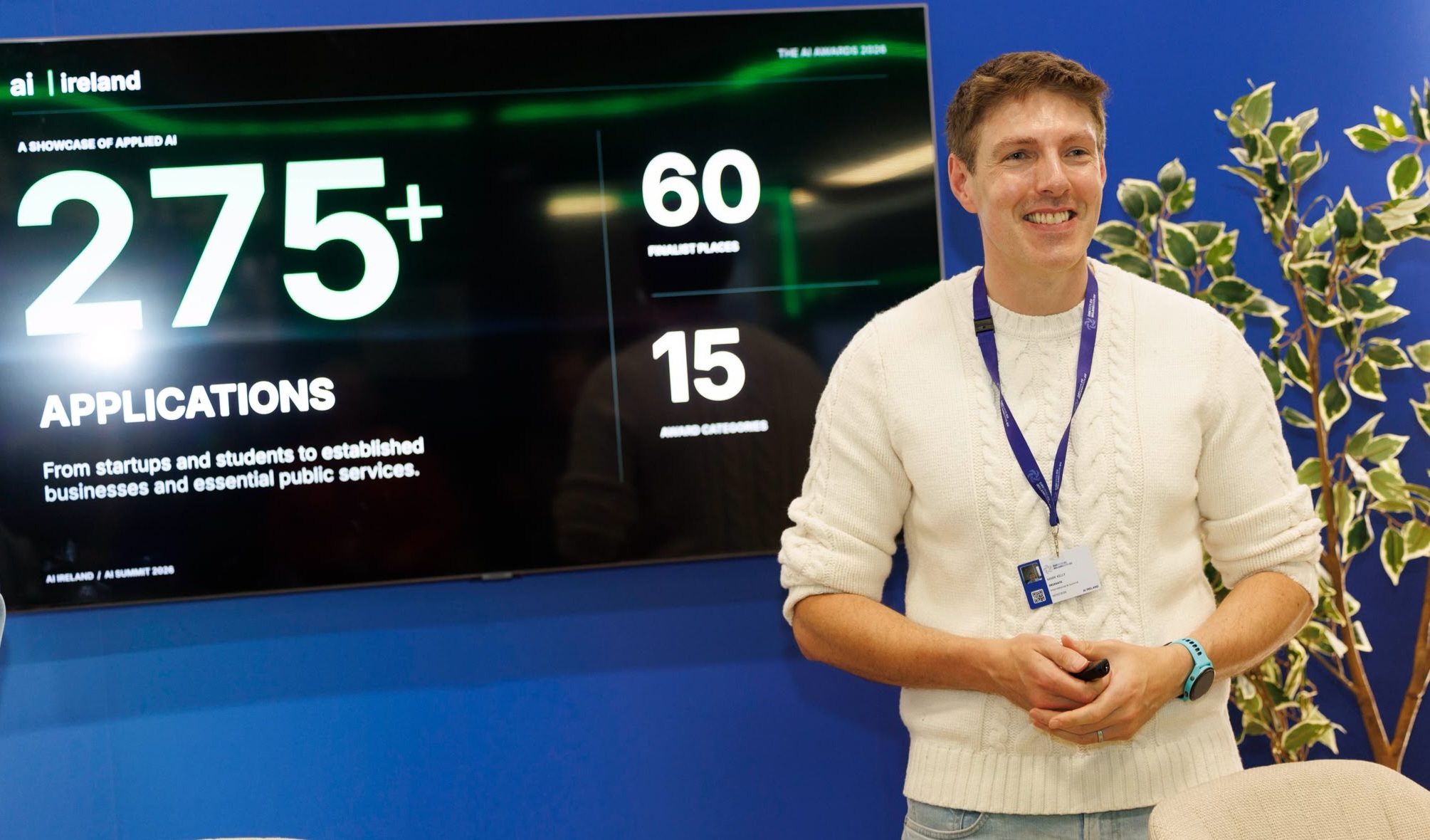
One of my personal highlights was the opportunity to present at the Meta stand and showcase some of the innovation emerging through the AI Awards.
As Founder of AI Ireland and the AI Awards, I have had the privilege of seeing how artificial intelligence is being applied across the island of Ireland.
This year’s Awards, taking place on 17 November 2026, will recognise 60 finalists across 15 categories.
The applications demonstrate the breadth of innovation happening across healthcare, sustainability, cybersecurity, public services, customer experience and enterprise.
What I find particularly encouraging is the diversity of organisations involved.
AI innovation is not limited to large technology companies.
Start-ups, small businesses, universities, public bodies and established enterprises are all developing practical applications.
The projects also demonstrate two distinct opportunities for organisations.
The Blue Euro: Using AI to Save Money
I often use the term Blue Euro to describe AI applications focused on efficiency and productivity.
These are initiatives that help organisations reduce costs, save time and improve existing processes.
Examples include automating administration, reducing equipment downtime, improving reporting and accelerating customer service.
These benefits can often be measured relatively quickly.
The Green Euro: Using AI to Make Money
The Green Euro represents another opportunity.
This is where AI helps businesses create new products, develop new services, enter additional markets or generate revenue.
A company might use AI to introduce a new customer service offering or turn its specialist expertise into a scalable digital product.
Both approaches matter.
But I believe more leadership teams need to explore the Green Euro opportunity.
AI is not just a tool for doing the same work faster. It can help businesses rethink what they offer customers.
That is one of the most exciting trends emerging through the AI Awards.
8. Businesses Need to Move Beyond AI Experiments
A common challenge I see when working with organisations is that AI adoption often begins with individual enthusiasm.
An employee discovers ChatGPT.
Another starts using Microsoft Copilot.
Someone else experiments with an AI agent.
These are useful starting points.
But individual productivity gains do not automatically translate into organisation-wide improvements.
Consider a customer service team.
Using AI to draft responses faster might save time.
But what happens if the organisation redesigns the entire customer support process?
AI could potentially help classify enquiries, retrieve approved information, prepare responses, identify urgent cases and support staff with recommended next steps.
That creates a much larger opportunity.
The distinction is between improving an individual task and improving an entire process.
This is where leadership becomes critical.
Organisations need to identify priorities, involve employees, establish governance and measure outcomes.
AI adoption should be measured by business impact, not simply by the number of people using AI tools.
9. My 5Ps Framework for Practical AI Adoption
When I work with CEOs, boards and leadership teams, I use a simple framework to help organisations assess their readiness for AI.
I call it the 5Ps AI Readiness Framework.
People
Do employees have the knowledge, confidence and support to use AI effectively?
Process
Which business processes offer the greatest opportunities for improvement?
Platforms
Does the organisation have access to suitable AI tools and technology?
Proprietary Data
Is business information accurate, accessible, secure and ready to support AI applications?
Products & Services
How can AI improve existing offerings or create entirely new opportunities for customers?
These five areas are connected.
An organisation might purchase excellent AI software, but if employees lack confidence or the underlying data is poor, the results will be limited.
Similarly, employees may be enthusiastic about AI, but without clear business priorities, experimentation can become disconnected from meaningful outcomes.
The objective is to bring people, processes, technology, data and commercial opportunities together.
I encourage leadership teams to start with a small number of high-value opportunities.
Identify the business problem.
Understand the current process.
Test how AI could help.
Measure the results.
Then expand what works.
This is a much more sustainable approach than introducing AI everywhere without a clear purpose.
10. What Business Leaders Should Do Next
If I were to summarise the practical implications of the summit for business leaders, I would focus on five priorities.
First, identify where AI can create measurable business value.
Look beyond individual productivity tools and examine complete business processes.
Second, invest in employee skills and confidence.
Give people opportunities to learn, experiment and share practical examples.
Third, establish clear governance.
Define responsibilities, permissions and human approval requirements before introducing more autonomous AI systems.
Fourth, use your organisation’s own knowledge and data.
Generic AI capabilities are increasingly accessible. Your proprietary information, expertise and customer understanding can create greater differentiation.
Finally, explore new products and services.
Do not limit the conversation to reducing costs.
Ask how AI could help your business generate new revenue and deliver better customer experiences.
These are the discussions I believe every leadership team should be having.
Final Thoughts: The Time to Kick On Is Now
The International AI Summit was a fantastic opportunity to hear from some of the world’s leading voices in artificial intelligence.
From Demis Hassabis discussing the potential to transform healthcare to Sarah Friar highlighting the rise of AI agents and Brad Smith reinforcing the importance of responsible innovation, the conversations demonstrated how quickly this technology is evolving.
It was also encouraging to see Ireland positioning itself for the next phase of AI adoption through the Intelligence programme.
For me, however, the most important message is that Ireland is not starting from zero.
Through the AI Awards, we already see organisations across the island applying artificial intelligence to solve meaningful problems.
The opportunity now is to help more businesses build on those successes.
My biggest takeaway is simple.
Europe needs to move from AI ambition to AI application.
And for Ireland:
We are already applying AI. Now we need to scale what works.
Thank you to Meta for inviting me to present at the summit and to everyone I had the opportunity to meet throughout the day.
The time to kick on is now.
About Mark Kelly
Mark Kelly is an AI keynote speaker, business advisor and Founder of AI Ireland and the AI Awards.
He works with CEOs, boards and leadership teams to help organisations move beyond AI awareness and achieve practical business outcomes.
Through executive briefings, leadership workshops and AI adoption programmes, Mark helps businesses save time, improve decisions, enhance customer experiences and identify new opportunities for growth.
Learn more at markkellyai.com.
Share This Story, Choose Your Platform!
Planning an event or leadership offsite?
Mark Kelly delivers evidence-based AI keynotes and hands-on AI leadership workshops for boards, executive teams and conferences across Ireland and Europe.