How to Learn AI as a Leader: Practise Where Failure Is Free
Last updated: July 2026
If you want to learn AI as a leader, stop practising on work that matters.
That sounds like bad advice. It is the opposite. Most leaders try to learn AI on high-stakes problems, under pressure, in front of people. It goes badly, it is embarrassing, and they quietly stop.
The people who get good at this practise somewhere else first. Somewhere failure is free.
Everyone is overwhelmed, including the people building it
I am overwhelmed.
The leaders I work with are overwhelmed. And so are the people inside Microsoft and OpenAI. I am not being modest. The pace is genuinely faster than any individual can track, and that is true whether you are a CEO in Cork or an engineer in San Francisco.
That is worth saying out loud, because most people assume the overwhelm is a personal failing. It is not. It is the condition. Over a billion people are now using these tools, and the capability moves every few weeks.
Once you accept that nobody has caught up, a useful question appears. Not “how do I keep up?” You cannot. The question is “what can I actually control?”
You control three things. Where you practise. How often. And whether you do it yourself or delegate it to someone else.
The mistake leaders make when they try to learn AI
Here is the pattern I see over and over.
A board asks what the AI strategy is. The pressure lands on one executive. That executive, wanting to move fast, picks something important. A customer process. A financial report. A live client deliverable.
They try it. The output is mediocre, or confidently wrong, or needs so much correction it would have been faster to do it themselves.
They conclude the technology is overhyped. They stop.
What actually went wrong is that they chose a first attempt where being bad was expensive. Nobody learns anything under those conditions. You would not learn to drive on a motorway.
In our own survey of 215 leaders, skills and resources was the third biggest blocker to AI adoption, at 13.1%. Notice that it is a skills problem, not a technology problem. And skills come from repetition, which requires somewhere safe to repeat.
The big idea: practise where failure is free
Choose problems where a wrong answer costs you nothing.
No colleague sees it. No client is affected. No deadline moves. If the output is rubbish, you shrug and try a different prompt.
This does two things at once. You build real judgement about what these tools are good and bad at, which is the thing you cannot get from a briefing. And you remove the fear that stops most people going back a second time.
Then, and only then, you take that judgement to work that matters.
What free failure actually looks like
Two examples from my own week. Both are deliberately unimpressive.
The fridge. I take a photo of what is inside my fridge and ask for dinner options using only those ingredients. If the suggestion is bad, I make something else. Total cost of failure: nothing.
The bike. Something is rattling. I photograph it and ask what it is and how to fix it. Sometimes the answer is wrong. I find out immediately, because the rattle is still there.
These look trivial. They are not. In both cases I am learning the same things I need at work: how to give an AI enough context, how to spot a confident wrong answer, when a photo beats a paragraph of description, and how to ask a better second question.
The stakes are zero. The skill transfers completely.
The one that changes your working week
Once the low-stakes reps are in, here is where it starts paying.
Take a transcript of a meeting you were in. Strip out everyone else. Keep only what you said. Then ask what you missed, what you should have asked, and where you talked when you should have listened.
That is the highest return use of AI I have found for a leader, and almost nobody does it.
One important caution. A meeting transcript contains other people’s words, which makes it personal data. Do not put colleagues’ contributions into a tool without knowing your organisation’s policy and your legal basis. Analysing only your own contributions removes the problem entirely, and it is the more useful exercise anyway. You cannot change what anyone else said.
The personal tutor move
The second habit worth building is simple. When you hit something you do not understand, ask to be taught rather than told.
“Teach me this step by step. Assume I know nothing. Check whether I have understood before moving on.”
Why this works: the instruction to check your understanding forces a back and forth instead of a lecture. You end up answering questions, which is when learning actually happens. Most people ask for an explanation, get four paragraphs, skim them, and retain nothing.
An honest word about growth mindset
This module is usually where a speaker cites Carol Dweck and the idea of fixed versus growth mindsets. I am going to be straight with you about that research, because you may well be quoting it inside your own organisation.
It has not held up well.
A 2018 meta-analysis in Psychological Science found the average effect of growth mindset interventions was tiny, roughly enough to move someone from the 50th to the 53rd percentile. A 2023 meta-analysis in Psychological Bulletin went further, concluding that apparent effects were likely down to weak study design, reporting flaws and bias. Attempts to replicate some of the most famous original studies have largely failed. Dweck herself has read the failed replications and acknowledged that implementation is far more complex than she first recognised.
So why mention it at all?
Because the framing is still a useful metaphor, even where the science is contested. Treating your ability with a new tool as something that grows rather than something you either have or do not is a sensible way to approach AI.
Just do not present it as proven science in a boardroom. Somebody will have read the same papers, and the moment they correct you, everything else you said becomes suspect.
The behaviour matters. The citation does not.
How to learn AI as a leader: what to do this week
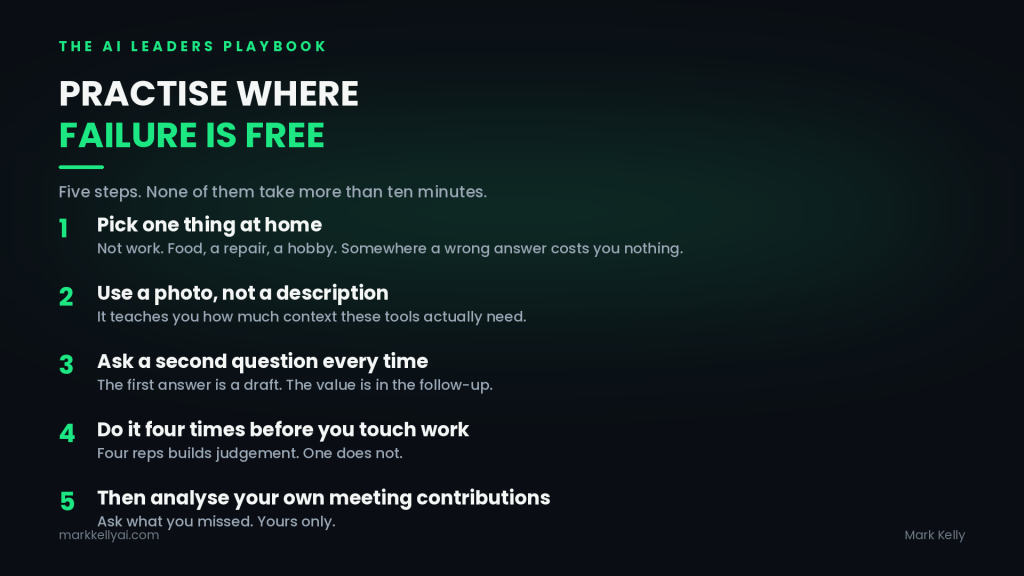
Five steps. None of them take more than ten minutes.
Frequently asked questions
How do I learn AI as a leader when I have no time? Ten minutes, four times, on something you were doing anyway. Learning AI does not require extra hours. It requires attaching the practice to tasks already in your week.
Should I delegate AI learning to my team? No. You can delegate implementation. You cannot delegate judgement. A leader who has never used the tools cannot tell a good use case from a bad one, or evaluate what their team is telling them.
Is it safe to put a meeting transcript into an AI tool? Not without checking. A transcript contains other people’s personal data. Check your organisation’s policy first, and consider analysing only your own contributions, which avoids the issue and is more useful.
Does growth mindset actually work? The research is contested. Meta-analyses have found small or null effects, and several high profile replications have failed. The framing remains a useful metaphor. It is not settled science.
How long before AI is useful in my actual job? Most people find something genuinely useful within a fortnight of regular low-stakes practice. The blocker is almost never capability. It is starting somewhere the cost of being bad is too high.
The bottom line
You cannot control the pace. You can control where you practise.
Get bad at this somewhere it does not matter. Then get good at it where it does.
Work with me
The fastest way to build this across a leadership team is a day in a room, working on your own processes, hands on.
That is what my executive AI workshops do. No theory, no vendor pitch.
About the author
Mark Kelly is an AI keynote speaker and workshop facilitator. He has delivered over 300 keynotes, trained more than 10,000 professionals and reviewed over 1,000 AI projects across sectors. He is the founder of AI Ireland.
References
- Sisk, V. F., Burgoyne, A. P., Sun, J., Butler, J. L., and Macnamara, B. N. (2018). To what extent and under which circumstances are growth mindsets important to academic achievement? Two meta-analyses. Psychological Science, 29(4), 549–571.
- Macnamara, B. N. and Burgoyne, A. P. (2023). Do growth mindset interventions impact students’ academic achievement? Psychological Bulletin.
- Li, Y. and Bates, T. C. (2019). Failed replication of Mueller and Dweck (1998). Journal of Experimental Psychology: General, 148(9), 1640–1655.
- Carol Dweck interview on the criticism of growth mindset, TES, 2020. https://www.tes.com/news/growth-mindset-where-did-it-go-wrong
- “Debate Arises over Teaching Growth Mindsets to Motivate Students”, Scientific American. https://www.scientificamerican.com/article/debate-arises-over-teaching-growth-mindsets-to-motivate-students/
- AI Ireland Leaders Survey 2026, second half. 215 responses. Self-selected respondents from the AI Ireland network.
Share This Story, Choose Your Platform!
Planning an event or leadership offsite?
Mark Kelly delivers evidence-based AI keynotes and hands-on AI leadership workshops for boards, executive teams and conferences across Ireland and Europe.