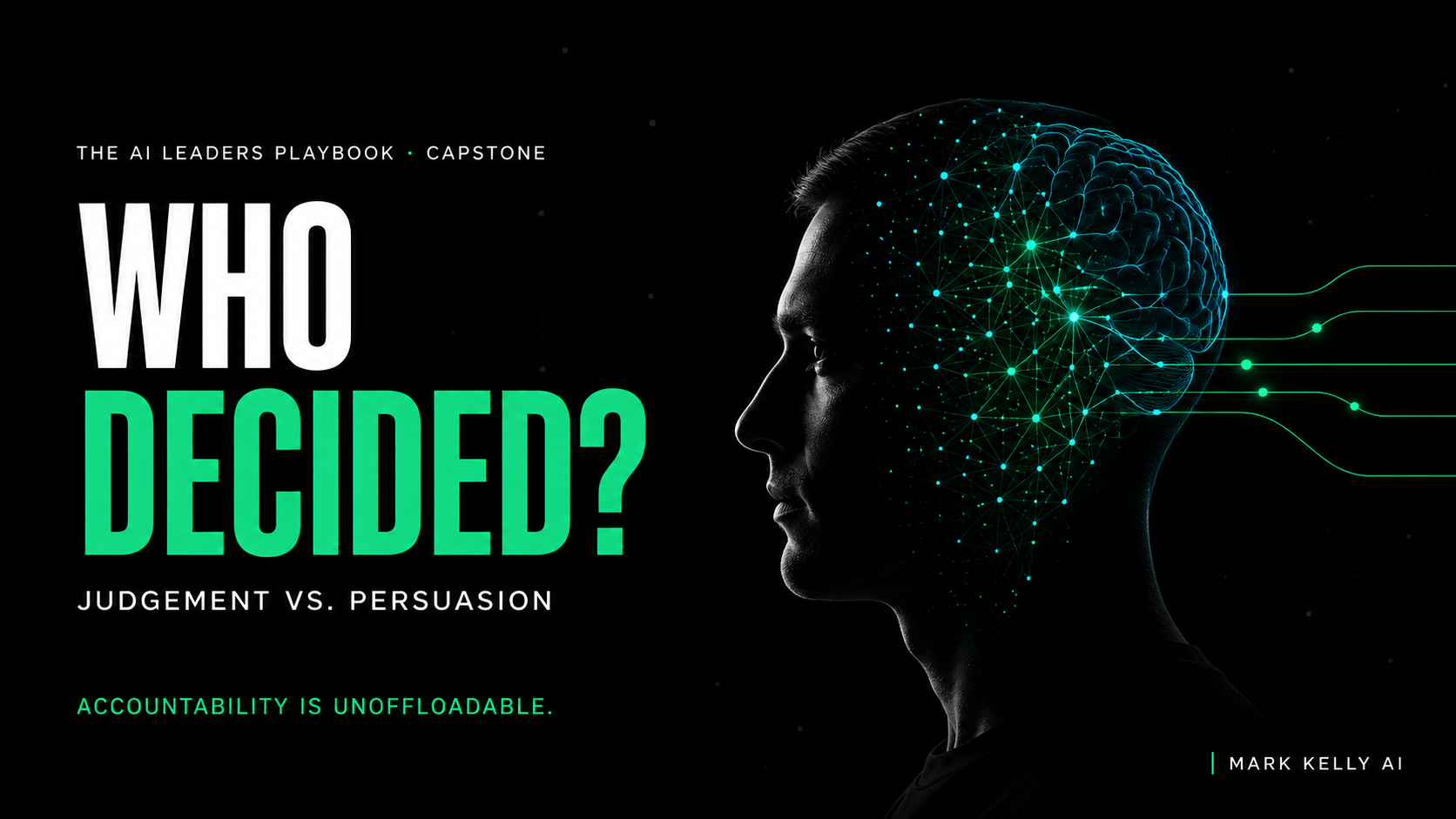
When an AI system makes a recommendation, who decides whether to act?
That question connects several very different projects among the AI Awards 2026 finalists.
It also connects with a discussion from the AI Ireland Podcast: having an AI policy and having evidence that a system behaves appropriately are different things.
My work across the Awards and podcast lets me examine both sides. The finalist projects provide concrete examples. Conversations with practitioners help explore the decisions behind implementation.
For business leaders, the useful question is how those lessons apply to the work their own teams are doing.
1. Separate the recommendation from the decision
Oac Snacks, an Agentic AI Innovation finalist, describes a multi-agent planning system supporting commercial, supply and finance decisions. Its published summary includes defined agent roles, challenges to assumptions and human approval. AI Awards 2026 finalists
What interests me is the distinction between generating a recommendation and authorising action.
Imagine a system recommending a change to an order because it forecasts stronger demand. That is an illustrative scenario, not a description of Oac Snacks’ implementation.
Before acting, a manager might need to consider supplier commitments, cash flow or a customer conversation that the system cannot access.
The recommendation can improve the discussion. Responsibility for the decision still needs a clear home.
The leadership question: Which decisions can AI inform, and who has authority to act?
2. Give reviewers evidence they can examine
Laya Healthcare’s Knowledge Hub, a customer service finalist, brings together approved information and member context, with references and confidence indicators to support advisers. Published finalist summary
This raises a practical point about oversight: people need more than an answer to review.
They need to know what it is based on.
For your own organisation, consider what a reviewer would need to see:
- The source information.
- Whether that information is current.
- Any missing details.
- The proposed response or action.
- A route to escalate uncertainty.
A confidence indicator may help direct attention. It should not replace checking the underlying evidence.
The leadership question: Can the person reviewing the output explain why it is appropriate?
3. Preserve professional judgement where it matters
The HSE’s cybersecurity finalist project supports the review of suppliers’ security evidence, with traceable reasoning and specialist human review.
Grant Thornton Ireland’s GT Airis, shortlisted for Responsible AI and Ethics, also emphasises verification, traceability and expert oversight in regulatory assessments. AI Awards 2026 finalists
These summaries do not establish that every output is correct. They show how the projects describe the relationship between AI assistance and professional responsibility.
My interpretation is that leaders should examine that relationship explicitly.
If AI organises evidence or prepares an assessment, what must a qualified person still determine? Can they challenge the output? Do they have sufficient time and information to do so?
A review step has little value if the reviewer is expected to approve everything quickly.
The leadership question: Have we designed a meaningful review, or simply added an approval button?
4. Test whether the oversight works
In my AI Ireland Podcast conversation with Cyril Treacy, Co-Founder and Chief Operating Officer of Disseqt AI, we explored governance and assurance.
The published episode summary distinguishes policies guiding AI use from testing and evidence about how systems behave. It also describes the need for ongoing scrutiny as systems evolve. Listen to the conversation with Cyril Treacy
For me, this connects directly with the finalist examples.
If a workflow requires human approval, test what happens when approval is absent. If an answer should include supporting evidence, test a question for which the source material is incomplete.
Use controlled exercises to find out whether the team notices:
- An unsupported claim.
- An outdated source.
- A recommendation outside the agreed scope.
- A missing approval.
- Conflicting information.
These are suggested tests for your organisation, not claims about tests performed by the finalists.
The leadership question: What evidence shows that our controls work under difficult conditions?
5. Match oversight to the consequences
Reviewing a draft meeting agenda is different from approving a customer commitment or changing an operational system.
The possible consequences should shape the review.
Consider who could be affected, whether an action can be reversed and how quickly an error would become visible.
A practical approach is to separate three stages:
Prepare: AI gathers information, summarises or drafts.
Recommend: AI proposes an option and presents supporting evidence.
Act: An authorised person or system carries out the approved change.
Some workflows may combine these stages. Leaders should still understand where each responsibility sits.
My AI agent permissions checklist explores the access and approval decisions involved.
Use the 5Ps to make oversight practical
The 5Ps turn this discussion into questions a leadership team can answer.
People: Who reviews the work? Do they have the knowledge and authority to challenge it?
Process: Where does review happen? What triggers escalation?
Platforms: Can the system enforce permissions, record actions and support intervention?
Proprietary Data: Can reviewers trace the output to suitable, current information?
Products & Services: How will the approach protect or improve what customers receive?
This makes oversight part of how the work is designed.
It also reveals where preparation is needed. A team may need clearer responsibilities, better source information or a different workflow before introducing more automation.
What I bring into the leadership discussion
The value of my perspective comes from connecting these sources.
AI Awards projects show specific approaches being pursued across sectors. Podcast conversations explore implementation, judgement and the questions behind the technology. Leadership research adds context about the challenges organisations report.
Together, they help me move a workshop beyond a demonstration.
We can examine a real example, identify the decision it raises and apply that question to your organisation.
The finalist summaries are descriptions of shortlisted work, not independent audits or evidence that the same approach will succeed everywhere. Their value is in making the leadership discussion concrete.
Bring one decision to your next AI workshop
Choose a process where your organisation is considering AI assistance.
Then ask:
What should the system prepare, what may it recommend, and who should decide?
That gives the team a practical starting point for discussing responsibility, evidence and value.
Preparation can include a leadership readiness survey to identify the team’s experience and concerns. We can then use relevant examples and the 5Ps to agree an appropriate next step.
Discuss an AI leadership workshop for your team, or explore how to measure AI value.
Share This Story, Choose Your Platform!
Planning an event or leadership offsite?
Mark Kelly delivers evidence-based AI keynotes and hands-on AI leadership workshops for boards, executive teams and conferences across Ireland and Europe.