Prompt and Assemble: The New Way Teams Solve Everyday Problems with AI
For decades, businesses had two choices when they needed new software: buy an off-the-shelf platform or join the queue for a custom solution.
AI is creating a third option: prompt and assemble. It allows teams to build custom AI tools around clearly defined business problems—without replacing their core systems.
Buy an off-the-shelf platform designed for thousands of other organisations, or join the queue for a custom solution from the technology team.
AI is creating a third option: prompt and assemble.
This does not mean every employee suddenly becomes a software engineer. It means the people closest to the work can now help turn a clearly defined problem into a small, useful tool—often by combining an AI assistant with approved company data, existing software and simple automation.
The goal is not to replace every major business platform. It is to solve the awkward gaps between those platforms: the repetitive tasks, manual handovers and local problems that are rarely important enough to become major technology projects.
That is where a significant new source of business innovation is emerging.
From Buying More Software to Solving a Precise Problem
Traditional software is built for a broad market. It usually includes far more features than any one team needs, but it may still fail to support the exact way that team works.
AI changes the starting point.
Instead of asking, “What platform should we buy?”, teams can begin with a more useful question:
What recurring problem are we trying to remove?
That shift matters.
A finance team may not need another large platform. It may need a simple tool that identifies duplicate invoices and highlights missing purchase-order details for review.
A customer-service leader may not need a new reporting suite. They may need a daily summary of complaints, recurring themes and issues requiring escalation.
An operations team may not need a complex project-management system. It may need meeting notes turned into an accurate action list, with an owner and deadline attached to each task.
These are not replacements for core financial, customer or operational systems. They are focused tools that reduce the friction around them.
I Am Already Working This Way
In my own work, I use AI to solve several recurring problems.
I have AI monitor competitor websites and highlight meaningful changes. It helps me scan incoming emails and identify what may need my attention. I use it to turn verified AI news into the first draft of a daily article. I also use it to review my website and identify opportunities to improve search visibility and visitor conversion.
Each workflow has a narrow purpose. None is asked to run the entire business. Each removes a recurring piece of work while leaving judgement and final decisions with me.
This is the practical opportunity for most organisations.
Do not begin by asking how AI can transform the whole company. Begin by identifying the small pieces of work that waste time every week.
The People Closest to the Work Often See the Best Opportunities
The most valuable ideas do not always begin in a board meeting. They often begin with the person who performs the same frustrating task every Monday morning.
That person understands where information gets lost, where customers are kept waiting and where people repeatedly copy information from one system into another.
Until recently, spotting the problem and building the solution were completely separate activities. An employee could explain the need, but delivering it required budget, specialist skills and a place in the development queue.
AI shortens the distance between the person who understands the problem and the first working version of a solution.
That does not remove the need for technology expertise. It changes where that expertise creates the greatest value. Technology teams can spend less time building every small request and more time providing secure platforms, reusable components, data access, testing standards and clear boundaries.
The business brings the problem. Technology provides the safe environment. Together, they can move faster.
The Answer to Shadow AI Is a Safer Route to Innovation
Employees are already experimenting with AI. Some are uploading information to unapproved tools, creating their own automations or using AI-generated code they do not fully understand.
Simply telling people to stop is unlikely to work. Encouraging unrestricted experimentation is equally dangerous.
The better response is to create a governed route for employee-led innovation.
Teams need to know:
- which AI tools they may use;
- what information may and may not be entered;
- which activities require human approval;
- how a new tool should be tested;
- who owns it after launch; and
- how access can be removed if something goes wrong.
The objective is not Shadow AI. It is visible, supported and accountable AI innovation.
From a Useful Prompt to a Dependable Workflow
A prompt can help someone complete a task once. A workflow helps the organisation complete it consistently.
For example, an AI workflow could:
- collect approved information at a scheduled time;
- organise and analyse it;
- identify unusual items or missing information;
- prepare a recommended response or action; and
- send the result to a person for review.
This is the practical meaning of an AI agent in business: a system that can complete several defined steps towards an outcome, within agreed limits.
The important words are defined and limited.
An agent should not receive unlimited access and a vague instruction to “optimise the business”. It should have a clear job, approved information, specific permissions and a point at which a person takes responsibility.
Five Questions to Ask Before Building
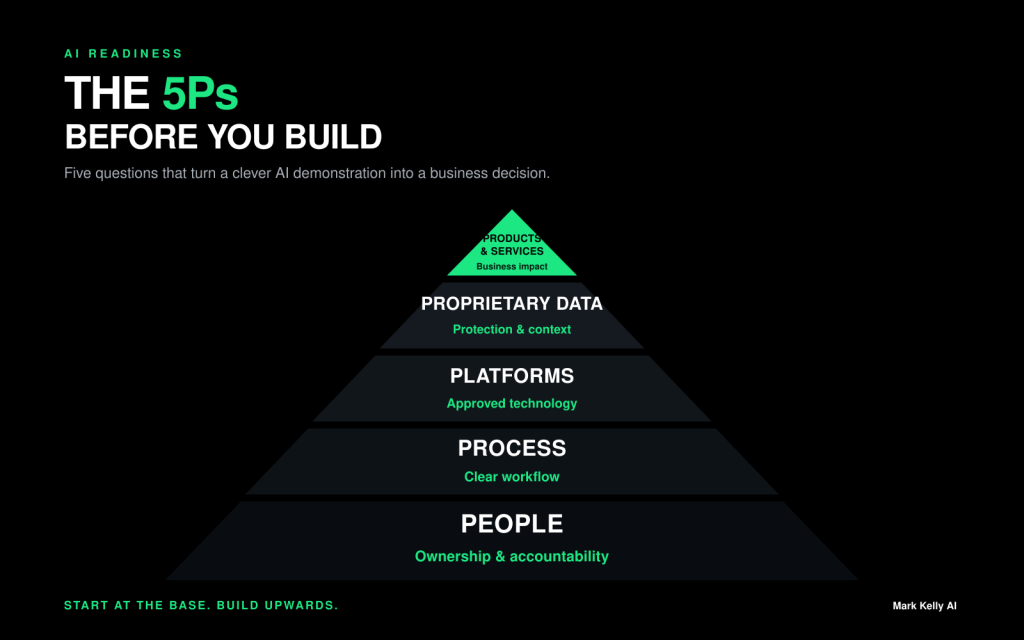
Start with people and build upwards. The 5Ps help leaders turn a promising AI idea into a safe, practical business decision.
I use the 5Ps AI Readiness Framework to help leaders assess whether an AI opportunity is useful, realistic and safe.
1. People
Who owns the problem, the tool and the final decision? Every AI workflow needs a named business owner.
2. Process
Is the existing process understood? Automating a confused or unnecessary process usually creates a faster version of the same problem.
3. Platforms
Can the tool be created using approved technology? Security, permissions, reliability and ongoing support need to be considered from the beginning.
4. Proprietary Data
What company, employee or customer information will the tool access? Sensitive information should only be used within systems and agreements designed to protect it.
5. Products and Services
Will the tool improve speed, quality, cost or customer experience? If the business outcome cannot be explained clearly, it may not be worth building.
These questions turn a clever demonstration into a business decision.
What Teams Should Not Build Casually
The fact that something can be built quickly does not mean it should be deployed quickly.
Extra care is required when a tool could influence:
- recruitment or employee evaluation;
- clinical or medical decisions;
- credit, insurance or financial eligibility;
- legal advice or contractual commitments;
- pricing decisions with a significant customer impact;
- access to sensitive personal or company information; or
- messages and actions sent externally without human review.
In higher-risk work, AI may still assist with preparation, summarisation or checking. However, testing, professional oversight and clear human accountability become essential.
Speed is valuable. Trust is more valuable.
A Practical 30-Day Starting Point
Leaders do not need a year-long programme to test this opportunity. They can begin with one controlled experiment.
Week 1: Find the friction
Ask each team to identify three repetitive tasks that waste time, delay a customer or require information to be moved manually.
Week 2: Select one low-risk opportunity
Choose a frequent, clearly defined task that does not involve a high-stakes decision. Agree what a successful result would look like.
Week 3: Build the smallest useful version
Use approved tools and limited data. Keep a person in the process and avoid adding unnecessary features.
Week 4: Test and measure
Track time saved, quality, errors and user feedback. Document who owns the workflow, what information it uses and what happens when it fails.
If the tool creates measurable value, improve it. If it does not, stop and apply the learning elsewhere.
That is how organisations move from scattered experimentation to genuine capability.
The Leadership Opportunity
The next phase of AI adoption will not be won by the organisation with the most demonstrations or the largest collection of AI subscriptions.
It will be won by organisations that help their people identify worthwhile problems, build small solutions safely and turn the best experiments into dependable ways of working.
The opportunity is not for every employee to become a software developer. It is to help the people closest to the work turn recurring problems into small, useful tools—within clear organisational guardrails.
That is prompt and assemble.
It is faster than waiting for every problem to become a major technology project. More focused than buying another broad software platform. And, when governed properly, it can turn everyday operational frustration into a repeatable source of innovation.
Ready to Move from AI Curiosity to Practical Results?
Mark Kelly helps boards, leadership teams and organisations turn AI potential into practical business action through evidence-based keynotes, executive briefings and leadership workshops.
Check Mark’s availability for your event or leadership session.
Share This Story, Choose Your Platform!
Planning an event or leadership offsite?
Mark Kelly delivers evidence-based AI keynotes and hands-on AI leadership workshops for boards, executive teams and conferences across Ireland and Europe.