The Supervision Trap: Autonomous Agents or Better Babysitting Software?
Platforms is the third P in my 5 P’s of an AI-ready business. People come first. Process comes second. But the agent era puts a hard question on the table that most leaders are dodging. Before you let autonomous agents run on their own, you need a platform built on real ground rules. This post explains the trap most companies have walked into, and the non-negotiables that get you out of it.
Every company says the same thing right now.
“We replaced the team with AI agents.”
Then the workflow meets reality.
The agents handle the clean path beautifully. The moment the customer says something odd, the policy has an exception, the data is messy, or the job needs judgment, the whole thing quietly waits for a human to push the ball forward.
This is where many autonomous agents stop being autonomous and start depending on hidden human intervention.
So the company hires people back. It gives them a dashboard. It asks them to watch the agents. And it calls the whole thing “human in the loop.”
I call this the Supervision Trap.
Claiming Level 4, running at Level 2
Many organisations believe their autonomous agents are ready for production, when in reality they still rely on constant human supervision.
Picture a refund agent. On a normal request it works in seconds. Then a customer turns up with a part refund, a damaged item, and a loyalty credit all at once. The agent stalls. A person steps in, sorts it out by hand, and the demo video never shows that bit.
In my maturity model, Level 4 is an agent that runs end to end with light oversight. Most firms claim they are there. In practice they are sitting at Level 2 or 3. Useful automation. Impressive demos. And a hidden human layer keeping the system alive.
The problem is not that agents are useless. They are already very useful. The problem is that “autonomous” has become the most expensive word in the pitch deck.
Here is the uncomfortable question to ask before you approve any agent workflow this week. Where does the human still enter the system, and have we designed that role honestly?
Are you building autonomous agents, or are you building better babysitting software?
Why this is a Platforms problem
People and Process come first for a reason.
Your People need the skills and the confidence to work with agents. Your Process needs to be redesigned so the work actually suits an agent, not just bolted on top of the old steps.
But you can have ready people and redesigned processes and still fail here. Because autonomous agents have to live somewhere. They need a secure platform to run, act, hold data, call tools, and make changes in real systems.. It has to run, act, hold data, call tools, and make changes in real systems. That place is the platform. It is the third P, and in the agent era it carries the most weight.
A platform built for chatbots is fine when AI only suggests. It is not fine when AI acts. When AI suggests a draft, the worst case is a bad sentence. When AI acts, it can issue the refund, send the email, change the record, or run the code. The moment an agent can take an action, the rules change.
The platform is the harness, not the model
The model is not your advantage. Everyone can buy the same model.
Your advantage is the harness you build around it. The scaffolding. The guardrails. The plumbing that decides what the agent can see, what it can touch, and what it must never do without a human.
This is the part nobody puts in the demo. It is also the part that decides whether you can deploy at scale or not. Most companies fall in love with the model and forget the harness. Then they wonder why the thing that looked magic in a pilot cannot be trusted in production.
This is also why companies such as Anthropic have written extensively about building effective agents—the model is only one part of a reliable agent system.
So before autonomous agents run on their own, the platform needs ground rules. These are the non-negotiables.
Four non-negotiables for an agent platform
Every organisation deploying autonomous agents should treat these capabilities as mandatory rather than optional.
- Fully inspectable. You can see what every agent is doing, in real time and after the fact. No black boxes acting on your business.
- Fully auditable. Every action leaves a trail. Who asked for it, what the agent did, what data it touched, and why. If you cannot replay it, you cannot trust it.
- Policy-governed execution. The moment an agent can write code and run it, that code runs inside an environment governed by policy. Not on someone’s laptop. Not with open access to everything.
- Constrained access and a stop button. The agent only reaches the data and tools it needs for the job. And you can step in and stop it the moment something goes wrong.
These are not nice to have. They are the floor. Cross that floor and you are not running agents. You are hoping.
Think of it like a new hire on day one. You do not give them the master keys, the company bank account, and a free run of every system. You give them the access the job needs, a manager who can see their work, and a way to step in. Agents deserve the same discipline, at machine speed and machine scale.
The real engineering challenge of this moment
This is one of the hard problems of the AI moment. Not the model. The infrastructure that has to get built as companies stand up the platform for agentic work.
If AI is going to amplify human ability at scale, we have to know what our agents are doing. We have to constrain what they can access. We have to be able to audit them and step in when something breaks.
That is what makes large-scale deployment possible. That is what earns trust. The alternative is launching millions of autonomous systems into production and hoping for the best.
That is not a strategy. It is a press release waiting to go wrong.
What this means for you as a leader
You do not need to build all of this yourself on day one. You need to stop pretending you are further along than you are.
Three honest moves:
- Name your real level. Be straight about where you sit, Level 2, 3, or 4. The marketing version helps no one.
- Map the human props. Find every place a person quietly keeps the system alive. Decide if that role is real design or a quiet rescue.
- Pick a platform with the floor built in. Inspection, audit, controlled execution, constrained access, and the power to intervene.
Get the platform right and your autonomous agents become something you can trust at scale. Get it wrong and you have built expensive babysitting software with a confident name.
People build the harness. Process, Platform, and Data are the harness. Products are the payoff. Platforms is where the era of autonomous agents will be won or lost. The businesses that succeed won’t simply deploy autonomous agents—they’ll build platforms that make those autonomous agents trustworthy, auditable, and safe to scale.
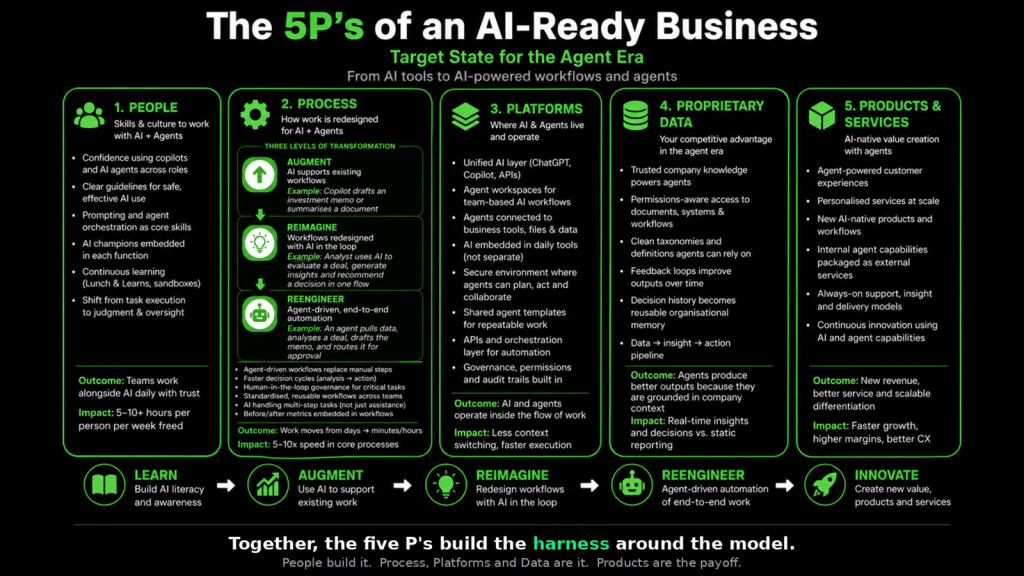
The 5 P’s of an AI-Ready Business provides a practical roadmap for AI transformation. The framework explains how People, Process, Platforms, Proprietary Data, and Products & Services work together to help organisations move from AI tools to AI-powered workflows and autonomous agents.
The 5P’s of an AI-Ready Business.
Book Mark to speak. I help boards and leadership teams cut the hype and build AI they can actually trust. If you want your people to understand agents, governance, and what a real platform looks like, book an executive workshop or keynote.
Mark Kelly is an AI keynote speaker, entrepreneur, and advisor, and the founder of AI Ireland. He has delivered 300+ keynotes and trained more than 10,000 professionals, and helps leaders put AI to work on real problems.
Share This Story, Choose Your Platform!
Planning an event or leadership offsite?
Mark Kelly delivers evidence-based AI keynotes and hands-on AI leadership workshops for boards, executive teams and conferences across Ireland and Europe.