Is the AI Bubble? What Business Leaders Should Do
Last updated: July 2026
Is the AI bubble real? Probably, yes. And it is still the wrong question to be asking.
The money is probably a bubble. The capability is not.
Those are two different questions, and most leaders are answering the wrong one. They read “bubble” and hear “wait”. Then they spend two years waiting, and the two years they lose are the two years their competitors spent learning.
A bubble takes your money. It does not take your capability.
This post separates the two, shows you evidence for both, including new data from 215 leaders in our own survey, and gives you something you can do this week.
The two questions leaders keep merging
Question one is financial. Are AI valuations, capital spending and financing structures overheated? That is a market question. It affects investors, pension funds and the share price of a handful of very large companies.
Question two is operational. Is AI good enough to change how work gets done in my organisation? That is a capability question. It affects your cost base, your hiring plan and your competitors.
You can answer yes to both. Most serious analysts do.
The two also run on different clocks. Markets can turn in a week. Capability moves in one direction and does not reverse. A company that cannot use AI well in 2026 will not suddenly be able to use it well because the Nasdaq fell.
Treat them as one question and you make a market bet with an operational budget. That is how leaders get this wrong.
The capability line has never bent
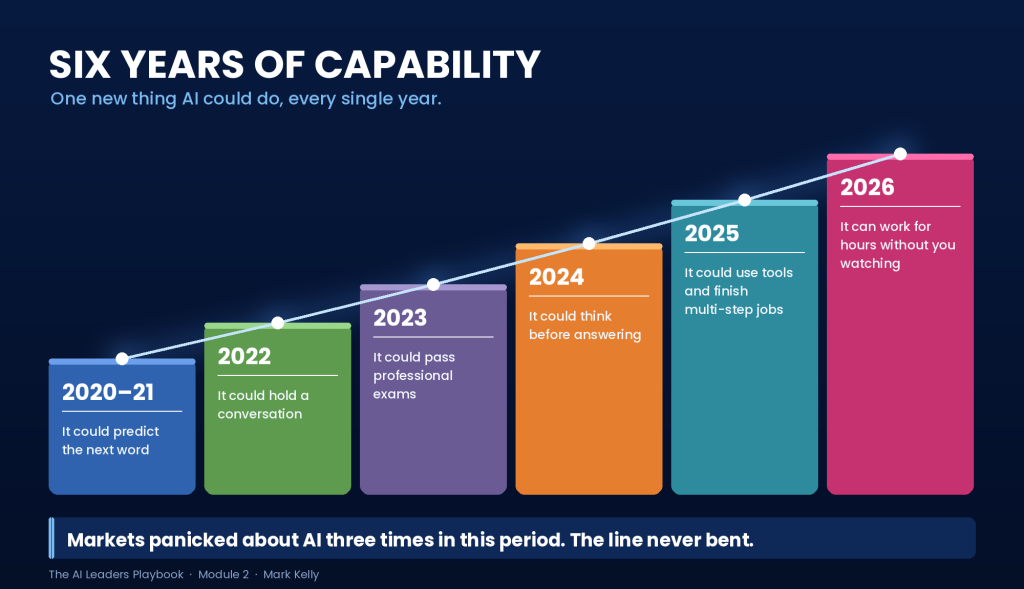
Six years, six new abilities. Markets moved up and down. The capability line only went one way.
One new ability per year.
- 2020 to 2021. It could predict the next word.
- 2022. It could hold a conversation.
- 2023. It could pass professional exams.
- 2024. It could think before it answered.
- 2025. It could use tools and finish multi-step jobs.
- 2026. It can work for hours without you watching.
Every one of those years contained a moment when serious people said the technology had peaked, or was overhyped, or that the money was about to run out.
The line never bent.
That matters more than any forecast. Forecasts are opinions about the future. The ladder is a record of what already happened.
The money really is stretched
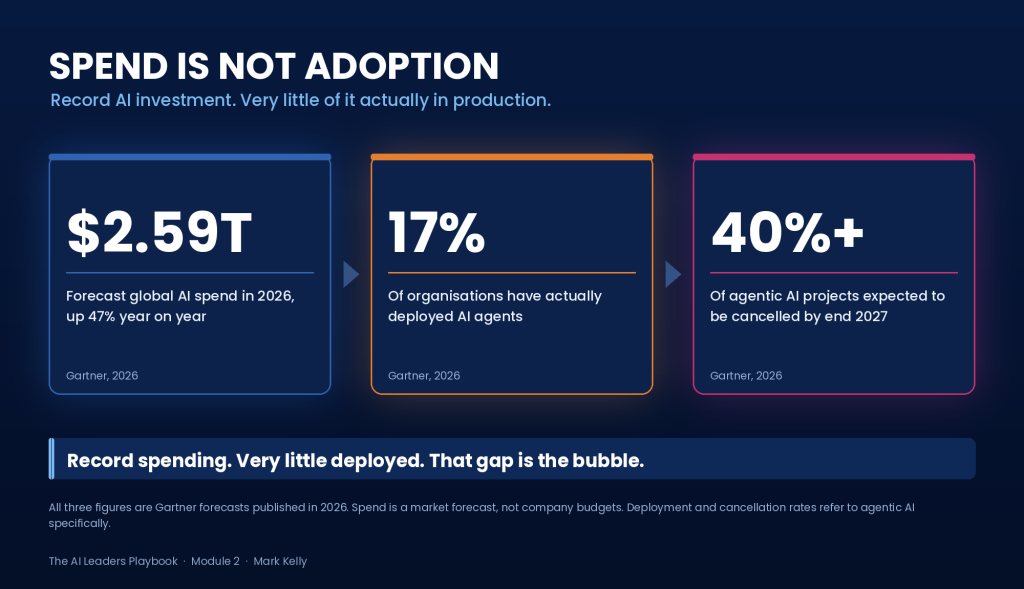
Record spending. Very little in production. That gap is where the bubble lives.
Now the other side, honestly.
Gartner forecasts worldwide AI spending of about $2.59 trillion in 2026, up 47% on the previous year. In the same research, only around 17% of organisations have actually deployed AI agents, and Gartner expects more than 40% of agentic AI projects to be cancelled by the end of 2027.
Record spending. Very little in production. That gap is where the bubble lives.
The Bank for International Settlements, which advises the world’s central banks, named the sustainability of the AI boom as one of four pressure points facing the global economy in its 2026 Annual Economic Report. It warned that disappointment in returns could turn the spending boom into a prolonged investment bust.
That is a serious warning from a serious institution. Take it seriously.
But read the same report to the end. It also found task-level time savings of roughly 20% to 50% across the research it reviewed, and estimated that AI added about one percentage point to US real GDP growth in 2025.
The financing may be fragile. The productivity is measurable. Both are true.
What our own data shows
We surveyed 215 leaders in the second half of 2026 through the AI Ireland network. Just over 72% hold manager-level roles or above. A quarter are C-suite or VP.
Two findings are worth sharing now.
Finding one: the leading edge is much further ahead than the market
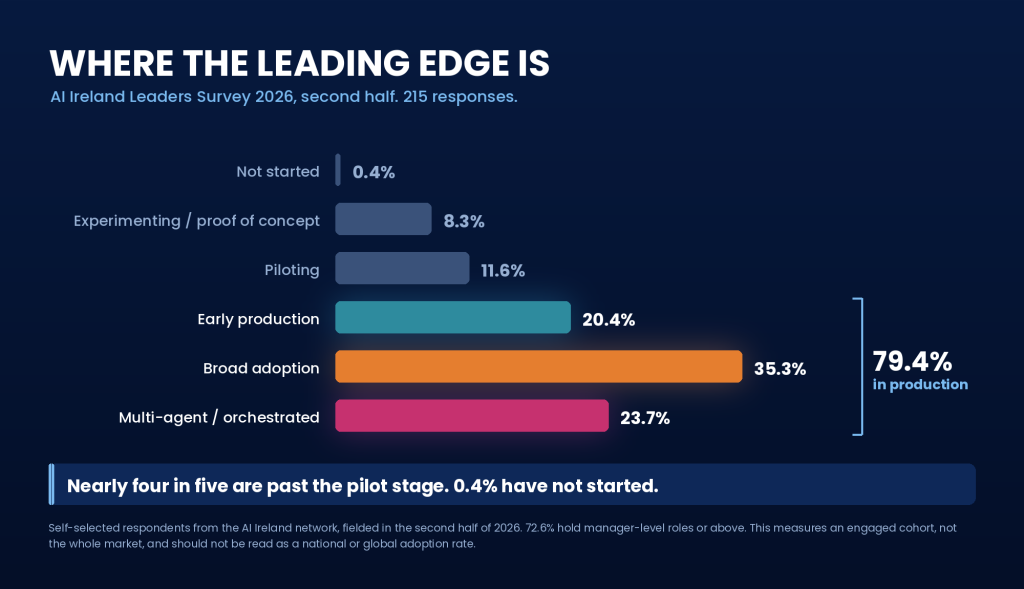
Nearly four in five are past the pilot stage. Respondents are a self-selected engaged cohort, not a representative sample.
Nearly four in five respondents are past the pilot stage. Almost a quarter are running multi-agent or orchestrated systems in production. Only 0.4% have not started at all.
Read that against Gartner’s 17% and it looks like a contradiction. It is not.
Our respondents are people who answer an AI survey. They are the engaged cohort, not a random sample of business. So the honest reading is this: the distance between the organisations that are moving and the ones that are not is enormous, and it is widening.
That is the part the bubble debate misses. While the argument about valuations continues, a group of organisations has quietly moved past the argument entirely. When they finish, you will not be competing with their pilot. You will be competing with their production system.
Finding two: nobody who is building is worried about ROI
We asked what the single biggest blocker is today.
| Blocker | Share |
|---|---|
| Governance and compliance | 17.8% |
| Integration challenges | 13.6% |
| Skills and resources | 13.1% |
| Data issues | 11.7% |
| Security concerns | 11.2% |
| ROI questions | 9.4% |
| Tooling immaturity | 7.9% |
Among people actually doing the work, “can we prove the value” and “is the technology good enough” are the two smallest blockers on the list.
Every blocker ahead of them is organisational. Governance. Integration. Skills. Data. None of those are fixed by buying a tool, and none of them get easier by waiting.
Notice also that no single blocker breaks 18%. There is no one thing to fix. That is exactly why single-tool AI strategies stall.
The full findings, covering agent patterns, sovereignty requirements, governance controls and testing practices, are published later this year. Request a copy.
What the companies getting value do differently
Across more than 1,000 AI projects, the pattern that separates the winners from the stalled is not budget, sector or size. It is two things.
1. They redesign the process, not just add the tool
Most organisations buy a licence and hand it out. The tool lands on top of a process built for humans doing every step by hand. Nothing changes, because nothing was allowed to change.
The leaders in our survey already know this. Asked what one use case they would start in the next 90 days, 54.5% chose workflow automation. Customer support assistants came in at 6.2%. They are not asking for chatbots. They are asking to rebuild how work flows.
Think of it like a dishwasher. Owning one saves you nothing if you still wash every plate by hand first. You have to change the routine, not just buy the machine.
2. The leaders use it themselves
The second pattern is simpler, and the one people avoid.
Where AI works, senior leaders use it personally. Not a demo. Not a briefing from the innovation team. In their own week, on their own work.
Where it stalls, leaders mandate it and delegate it. They approve the budget and never open the tool. So they cannot tell a good use case from a bad one, cannot judge what their teams tell them, and quietly stop asking.
You cannot lead a change you have never experienced.
What has changed in the room
Two shifts stand out over the last two years of running executive sessions.
The job question changed. Leaders used to ask “will AI take our jobs?” Now they ask “how do I redesign these roles?” That is a much better question. It means they have stopped treating AI as a threat to manage and started treating it as a design problem to solve. That argument is the core of my work on why tasks are not jobs.
The pressure changed. Two years ago leaders arrived curious. Now they arrive under pressure from their board. Someone upstairs has asked what the AI strategy is, and a real answer is expected.
Curiosity produces experiments. Board pressure produces rushed procurement. That is the exact condition in which organisations buy tools they do not need and cancel them eighteen months later.
What to do on Monday
Five steps. None need a large budget.
- Split your AI spending into two lists. List A is capability you keep: skills, process redesign, internal know-how. List B is capability you rent: vendor contracts, licences, platforms.
- Stress test list B. For each item, ask what happens if this vendor doubles its price, changes its terms or disappears. Anything you cannot answer is a risk, not an asset.
- Shift the balance towards list A. A bubble bursting destroys list B. It cannot touch list A.
- Pick one process, not one tool. Choose a workflow that is repetitive, high volume and irritating. Map it. Then decide where the technology belongs.
- Use it yourself for two weeks. One hour a week on your own real work. Highest return action on this list, and the one most leaders skip.
Frequently asked questions
Is AI a bubble? The financing shows classic bubble features: spending far ahead of revenue, circular deals between a small number of firms, and heavy debt. The technology is delivering measurable productivity gains. Both can be true at once, and usually are in major technology cycles.
Should we pause AI investment until it is clearer? Pause the spending you would lose in a downturn, such as long vendor lock-ins. Do not pause the spending you would keep, such as skills and process redesign. A pause on capability is a two-year gap you cannot buy back.
What happens to our AI projects if the bubble bursts? Prices for models and compute would likely fall, not rise. The main risk is vendor failure and contract disruption, not the technology becoming unavailable. Organisations with internal capability adapt. Organisations that outsourced their thinking do not.
Why do so many AI projects get cancelled? Most start with a tool rather than a process, and are sponsored by leaders who have never used the technology themselves. In our survey, the biggest blockers were governance, integration and skills. All organisational. None technical.
Is this like the dot-com bubble? It rhymes. The dot-com bubble destroyed enormous amounts of capital. It did not make the internet less important. The companies that kept building through it led the next twenty years.
The bottom line
The money is a bubble. The capability is not.
Bet on the thing you keep.
Work with me
If your board is asking what your AI strategy is, the fastest way to get a real answer is to put your leadership team in a room and work on your own processes for a day.
That is what my executive AI workshops do. No theory, no vendor pitch, hands on your actual work.
About the author
Mark Kelly is an AI keynote speaker and workshop facilitator. He has delivered over 300 keynotes, trained more than 10,000 professionals and reviewed over 1,000 AI projects across sectors. He is the founder of AI Ireland.
Survey methodology
AI Ireland Leaders Survey 2026, second half. 215 responses. Respondents were self-selected from the AI Ireland network and are not a representative sample of the wider economy. Role mix: 25.1% C-suite or VP, 23.7% Director or Head, 23.7% Manager or Lead, 13.0% Architect or Engineer. Adoption and blocker figures are drawn from questions 3 and 5. Percentages are rounded to one decimal place.
References
- Gartner, “Gartner Forecasts Worldwide AI Spending to Grow 47% in 2026”, 19 May 2026. https://www.gartner.com/en/newsroom/press-releases/2026-05-19-gartner-forecasts-worldwide-ai-spending-to-grow-47-percent-in-2026
- Bank for International Settlements, Annual Economic Report 2026, 28 June 2026. https://www.bis.org/publ/arpdf/ar2026e.htm
- Bank for International Settlements, “Global economic pressure points call for policy discipline”, press release, 28 June 2026. https://www.bis.org/press/p260628.htm
- AI Ireland Leaders Survey 2026, second half. 215 responses. Full findings published later in 2026.
Share This Story, Choose Your Platform!
Planning an event or leadership offsite?
Mark Kelly delivers evidence-based AI keynotes and hands-on AI leadership workshops for boards, executive teams and conferences across Ireland and Europe.