AI Custom Instructions: Build Your Personal Context Portfolio
You would never do this to a new hire.
Sit them down on day one. Tell them nothing about the company, the customers, the board, or the job. Hand them a task. Then read their work and conclude they were not very good.
That is how most leaders use AI. Then they decide the tool is overhyped.
The fix is a set of AI custom instructions I call your Personal Context Portfolio. It is a briefing document for your AI. It explains who you are, what matters to you and how you work. It takes about twenty minutes to write and you use it the same afternoon.
Why your answers come back generic
The gap between leaders who get useful answers from AI and leaders who get bland ones is almost never the model. Both are usually paying for the same subscription. One has told the tool something. The other has not.
Everything that makes your judgement useful sits in your head and never reaches the screen. Who you are accountable to. What you are actually measured on. Which three projects matter this quarter. What you cannot say in writing. The model is not withholding a better answer. It is guessing at a job nobody described to it.
So it gives you the safest possible answer: the average of everyone. That is exactly what generic means.
What the evidence says
The Work AI Index 2026, published by Glean’s Work AI Institute, surveyed 6,000 full-time digital workers across the US, UK and Australia between December 2025 and January 2026.
Three findings matter here.
Sixty percent of workers rerun the same prompt across multiple tools because the first output was not good enough. Their own words for what was wrong: too generic, too disconnected, or plain wrong.
Workers spend 2.3 hours a week loading context into AI tools. That is time spent typing in information the tool should already have had. Most of it is the same information, typed again.
More than half, 53 percent, say the critical information they need for their job is not accessible through their AI systems.
The most useful number in the whole report is a comparison. The researchers split workers into two groups: those who say the information they need is accessible through their AI tools, and those who say it is not.
| Outcome | Context-poor | Context-rich |
|---|---|---|
| Feel worn out by AI | 50% | 18% |
| Ship work they cannot explain | 54% | 26% |
| Rerun prompts across tools | 70% | 48% |
Same tools. Different briefing. Very different working life.
Two caveats worth stating plainly. Glean sells a platform that supplies enterprise context, so the conclusion suits the sponsor. And the sample skews more senior and more tech-heavy than the wider workforce. Read the direction of travel rather than the decimal points.
The big idea
AI is not underperforming. It is under-briefed.
This is the same pattern I see everywhere else in AI adoption. In why AI takes tasks, not jobs, the problem is leaders judging a tool against a job they never broke into tasks. In data readiness, the problem is leaders blaming the model for the mess it was fed. Here it is the same shape at personal scale. The input was never good enough to judge the output.
The Personal Context Portfolio: ten questions
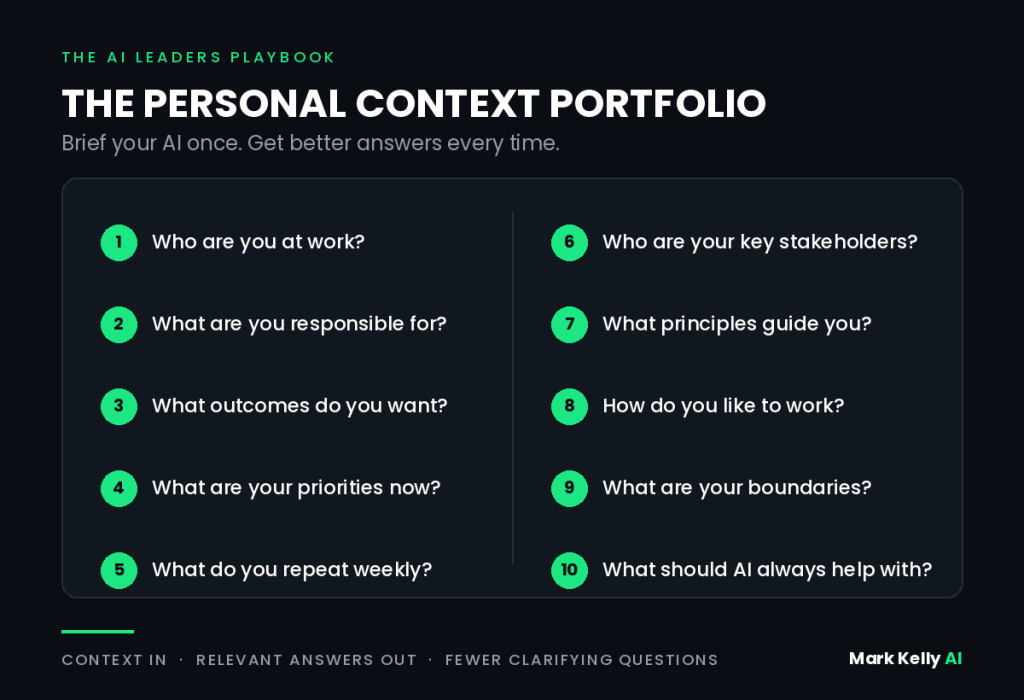
Ten answers, under 800 words, written once and reused.
Answer these in a single document. Keep the whole thing under 800 words. Then paste it into your custom instructions, or at the top of any important chat.
- Who are you at work, in three lines? Not your CV. What you do and who you do it for.
- What are you responsible for? Your title tells the AI your position. Your responsibilities tell it what you actually do. The second is far more valuable.
- What outcomes are you trying to achieve? Your scoreboard for this year.
- What are your current priorities and projects? This quarter only.
- What work do you repeat every week? The most useful question on the list. Be specific.
- Who are your key relationships and stakeholders? Use roles, not names.
- What principles guide your decisions? How you choose when the call is close.
- How do you prefer to communicate and work? Tone, length, format, level of detail.
- What constraints, risks or boundaries apply? Legal, commercial, regulatory, personal.
- What should the AI consistently help you with? Your standing brief.
Start with question five, not question one. It is the easiest to answer and it unlocks the vague ones. Most people stare at “what are your principles” for ten minutes, then write their weekly routine in ninety seconds and discover their principles were hiding inside it.
One addition that is worth more than any single answer: attach a sample of your own writing. A memo you were happy with, or a board update. Question eight describes your style. A sample shows it.
Short beats long
The same research carries a warning. For every 10 percent more time workers spend feeding AI context, they are 25 percent more likely to feel worn out by it. And loading more does not always help. Researchers call it context rot: past a point, extra material makes the output worse, not better.
Read carelessly, that says brief it less. It does not.
What exhausts people is reloading the same context into tool after tool, week after week. The portfolio is written once and reused. You pay for the context once instead of every Monday.
But it does set a hard rule: this is a briefing, not a dump. OpenAI caps custom instructions at 5,000 characters on paid plans and 1,500 on free ones. Five thousand characters is roughly 800 words. If your portfolio needs a scroll bar, it is working against you.
The line you must not cross
Your context is full of other people. Named staff. Salary bands. A restructure that has not been announced. A client dispute. A board matter.
Paste that into a personal consumer account and you have made a data protection decision without realising you were making one.
The rule is simple. Describe roles, not names. Say “my finance lead” and “a mid-size manufacturing client”, not real names. If you need the specifics, use an approved company account with the right agreement in place, and check your own policy first. This is the personal version of the shadow AI problem every organisation is now dealing with.
“But the tools remember me now”
Fair challenge. Memory has improved fast. OpenAI’s published evaluations show preference adherence rising from 31.4 percent in 2024 to 71.3 percent in 2026.
That is real progress, and it still leaves roughly three in ten preference tasks missed. It also leaves three problems a portfolio solves and memory does not.
- It is accidental. Memory picks up what you happened to mention, not what actually matters.
- It is hard to audit. OpenAI states that memory is a continually updated synthesis and that some details may not appear in the summary you can see.
- It is locked in. Your memory in one tool means nothing to the next one. A portfolio moves to a new model in ten seconds.
Deliberate beats accidental. Portable beats trapped.
Do this before Friday
Answer questions 2 and 5 only. Ten lines in total. Paste them above your next three prompts and compare the answers to last week’s.
Then diary a fifteen-minute review for the start of next quarter. Priorities change. A stale brief is worse than no brief, because you will trust it.
The takeaway
Every hour you spend re-explaining yourself to a machine is an hour you could have spent writing it down once.
The leaders getting real value from AI are not using better tools. They are giving better briefings. This is the same discipline as treating AI capability seriously while staying sceptical about the spending, and it sits underneath every one of the 5 P’s of AI readiness.
Write your ten answers. You will notice the difference by the third prompt.
Want your leadership team to build these together? I run hands-on AI workshops where every leader in the room leaves with their own Personal Context Portfolio, tested on their real work. Book a workshop.
Share This Story, Choose Your Platform!
Planning an event or leadership offsite?
Mark Kelly delivers evidence-based AI keynotes and hands-on AI leadership workshops for boards, executive teams and conferences across Ireland and Europe.