Enterprise AI Operating Model: The Two-Track Plan for Scaling AI Agents
Executive Summary
Artificial intelligence has moved through three stages: chatbots that respond, reasoning systems that solve complex problems, and AI agents that complete multi-step work. That third shift changes the leadership question from, “Which tool should we buy?” to, “How should we operate when digital workers act alongside our people?”
The answer is an enterprise AI operating model: broad workforce adoption connected to a smaller frontier team, supported by cost controls, engaged managers, organisational context and a fair employee bargain.
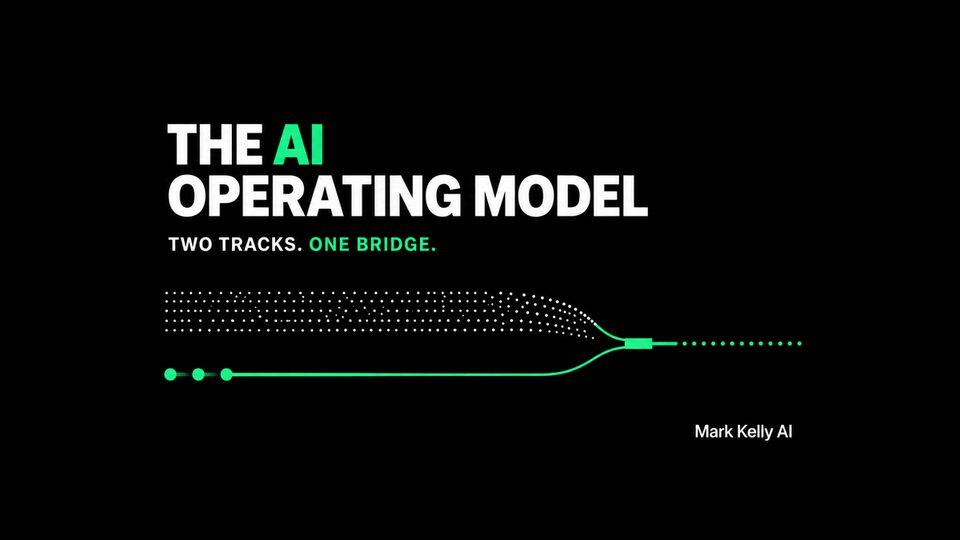
I call this the Two-Track Enterprise AI Operating Model. One track builds capability across the workforce. The other gives a small frontier team the resources to redesign work, services and products. A scaling bridge turns the best experiments into governed business capability.
AI is becoming a new operating layer across the five elements of my 5 P’s of AI Readiness: People, Process, Platforms, Proprietary Data, and Products and Services.
The Third Shift in Enterprise AI
The first phase was the chatbot era: enter a prompt and receive a draft, summary or answer. The second brought stronger reasoning, with AI examining evidence, solving problems and comparing options.
The third phase is AI agents. An agent can receive an outcome, use tools, complete steps and return a result. Several agents can divide work like a project team. They still make mistakes and need boundaries, but organisations are beginning to manage a digital workforce.
That is why building AI agents requires more than a good prompt. It requires context, tools, memory, approval points, verification and a clear operating structure around the technology.
Why the Operating Model Matters Now
The capability is moving faster than organisational design.
Deloitte’s State of AI in the Enterprise 2026 found that 84% of companies had not redesigned jobs around AI capabilities, despite high expectations for automation. Many organisations are effectively fitting a new engine to an old operating model.
Microsoft’s 2026 Work Trend Index makes a similar point. Moving from AI ambition to business impact requires redesign across employees, leadership and the organisation—not simply distributing more tools.
I see the same pattern in practice. Having reviewed more than 1,000 AI projects and trained more than 10,000 professionals, I rarely find that access to AI is the main constraint. The recurring problems are ownership, workflow design, context, confidence, governance and the route from a successful pilot into everyday work.
AI Economics Changes When Agents Keep Working
A chatbot costs money when someone uses it. An agent can keep consuming computing power while it searches, reasons, retries and delegates. Cost control therefore becomes a management issue.
Leaders should stop asking only, “What does the licence cost?” They should ask:
- What does each completed business outcome cost?
- Could a smaller model handle the task?
- After retries and human checking, is the result creating measurable value?
I call this performance per cost: delivering the required result reliably at a sensible cost. I explore it in Why Performance per Cost Matters More Than AI Models.
There is no universal investment ratio. Do not spend the entire budget on licences and computing. Fund training, process redesign, incentives, governance and adoption. Technology provides capability; organisational change creates value.
The Mark Kelly Two-Track Enterprise AI Operating Model
Most organisations either give everyone the same tools and expect transformation, or isolate experiments inside an innovation team that never changes everyday work. A better approach is parallel pathing: two tracks connected by a bridge.
Two tracks. One bridge. One controlled route from experimentation to scale.
| Element | Purpose | Primary measure |
|---|---|---|
| Track One: Workforce Adoption | Build confidence and improve everyday work | Adoption, time saved and work quality |
| Track Two: Frontier Team | Redesign important workflows, products and services | Cost, customer value, revenue or risk reduction |
| The Scaling Bridge | Turn proven experiments into governed capability | Repeatability, reliability and wider business adoption |
Track One: Whole-Company Adoption
Give the workforce safe access, training, approved use cases and sensible limits. Start with frequent, low-risk tasks such as meeting preparation, research, drafting and query triage. My guide to six practical ways companies use AI explains how to choose a measurable first use case.
Track Two: The Frontier Team
The frontier team should be small, cross-functional and protected from normal bureaucracy. It redesigns important workflows and tests products that could materially change cost, service or revenue. It may need better models, larger budgets and specialist support.
The Scaling Bridge
Proven experiments should become repeatable, governed workflows. Without this bridge, the frontier team becomes a laboratory with no route to impact; without the frontier team, adoption becomes a collection of small improvements.
The Employee Bargain Cannot Be Ignored
Executives focus on growth, productivity and cost. Employees may hear: “Do more work, faster, with fewer people.” That is the productivity trap.
If AI helps someone complete five days of work in three, what happens to the other two days? If the reward is only a larger workload, employees will hide efficiencies or resist adoption because it threatens their security.
Leaders need a fair bargain. Time saved should create better service, meaningful work, learning and opportunity—not permanent work intensification.
This is why AI readiness starts with people, not data. People are not necessarily resisting the technology. They are waiting to understand what it means for them.
In the second-half AI Ireland Leaders Survey 2026, skills and resources were the third-largest blocker, named by roughly one in eight respondents. The 230 leaders were self-selected from the AI Ireland network, so this is directional rather than nationally representative. The message remains useful: the reported barriers are largely organisational, not technical.
Middle managers translate strategy into daily habits. When they model thoughtful use, create safe practice and recognise experimentation, adoption grows. If they treat AI as another top-down demand, it stalls.
Executives must also become active users. They need not become technologists, but should experience delegation, context building, verification and agent failure before setting expectations for others.
Treat AI as an Operating Layer, Not Another App
Traditional software waits for a user. AI agents can work across systems, respond to events and coordinate activity, making AI more like an operating layer.
This requires a move beyond single-prompt behaviour. A high-quality AI workflow may:
- Gather information from approved sources.
- Build a brief using organisational context.
- Produce and test an output against agreed criteria.
- Request human approval where risk is high.
- Improve the work and record what happened.
This is loop engineering: designing how AI progresses, checks and improves instead of relying on one clever instruction.
Leaders must also distinguish efficiency from opportunity. Efficiency AI performs existing work faster. Opportunity AI asks what new service, product or revenue stream is now possible.
Give the frontier team permission to challenge the business. Could AI provide an always-on customer audit? Could a quarterly service become continuous? Could internal expertise become a digital product? If you do not explore how AI could disrupt your offer, a competitor will.
The Three Human Skills That Rise in Value
As agents become more capable, three human qualities become more valuable.
High agency means changing the approach, improving the context and continuing when the first attempt fails.
A sense of wonder is practical curiosity: asking, “What else can this do?” without chasing every product announcement.
Systems thinking means seeing inputs, handovers, decisions, risks and outcomes—and coordinating humans and agents across the workflow.
These qualities can be hired and developed. The goal is not to make everyone a technology specialist, but to build confident directors of digital work.
A Practical 30-Day Action Plan
Leaders can begin building an enterprise AI operating model with five actions.
1. Create the Two Tracks
Define what broad adoption should achieve and appoint a frontier team to tackle one material problem. Give each track an owner, budget and measure of success.
2. Crack the Context Puzzle
Identify the policies, examples, customer information, process knowledge and decision rules an agent would require. Connect only the sources it genuinely needs and assign ownership for keeping them current.
Generic AI is available to every competitor. Your proprietary context—how your organisation serves customers, makes trade-offs and judges quality—is where differentiation begins.
3. Move From Reactive to Proactive AI
Choose one workflow that can run on a schedule or business event: perhaps a customer-risk report, competitor monitor or operations alert. Start with recommendations before permitting automatic action.
4. Use Voice and Images
Capture richer context through dictation, meeting transcripts, screenshots, photographs and diagrams. The objective is faster, more complete communication with the system.
5. Establish Control Before Scaling
Agree what the agent may access, what it may do, when a person must intervene and how outcomes will be recorded. My articles on AI governance for business leaders and protecting decision accountability provide practical starting points.
The Leadership Question Has Changed
The first era of enterprise AI was about access. The next is about organisational design.
The winners will combine broad human capability with focused frontier experimentation, measure outcomes as carefully as usage and redesign work without losing accountability or employee trust.
AI agents are becoming part of the team. The leadership task is to decide how that new team will be funded, managed, governed and directed towards better business and customer outcomes.
The question is no longer whether your organisation will use AI. It is whether you will build an operating model capable of turning AI into repeatable, trusted advantage.
If your board, executive team or conference audience needs a practical roadmap for this shift, book Mark Kelly for an AI keynote or leadership workshop.
Frequently Asked Questions
What is an enterprise AI operating model?
It is the structure an organisation uses to fund, manage, govern and scale AI across people, processes, platforms, proprietary data, and products and services. It turns disconnected experiments into repeatable business capability.
Why do organisations need both an adoption track and a frontier team?
The adoption track builds widespread skills and everyday value. The frontier team tackles more ambitious workflow and product redesign. Connecting both allows proven experiments to scale safely across the organisation.
How should business leaders control AI agent costs?
Measure the cost per completed business outcome, use the level of AI capability the task genuinely requires, limit unnecessary retries and include verification costs. The objective is reliable business value, not maximum model usage.
What is the Two-Track Enterprise AI Operating Model?
It is Mark Kelly’s practical model for balancing organisation-wide adoption with focused frontier experimentation. Track One builds AI capability across the workforce. Track Two gives a small cross-functional team the resources to redesign important work. The scaling bridge converts proven experiments into safe, repeatable business workflows.
What is the first step in building an enterprise AI operating model?
Choose one measurable business problem, assign a clear owner and decide which track should handle it. Frequent, lower-risk productivity tasks belong in the workforce adoption track. Material workflow, product or service redesign belongs with the frontier team.
Sources and Further Reading
Share This Story, Choose Your Platform!
Planning an event or leadership offsite?
Mark Kelly delivers evidence-based AI keynotes and hands-on AI leadership workshops for boards, executive teams and conferences across Ireland and Europe.