AI Process Redesign: Augment Is Where You Learn, Reengineer Is Where You Earn
Ask a room of leaders what they use AI for. Almost every hand goes up for the same answer. Summarising. Drafting. Tidying up a document that already existed.
That is a real win. It is also the smallest one available.
Most organisations do one thing with AI. They make an existing step faster. Then they stop, write it up as a success, and wonder why the numbers never move.
Here is the line to hold on to.
Augment is where you learn. Reengineer is where you earn.
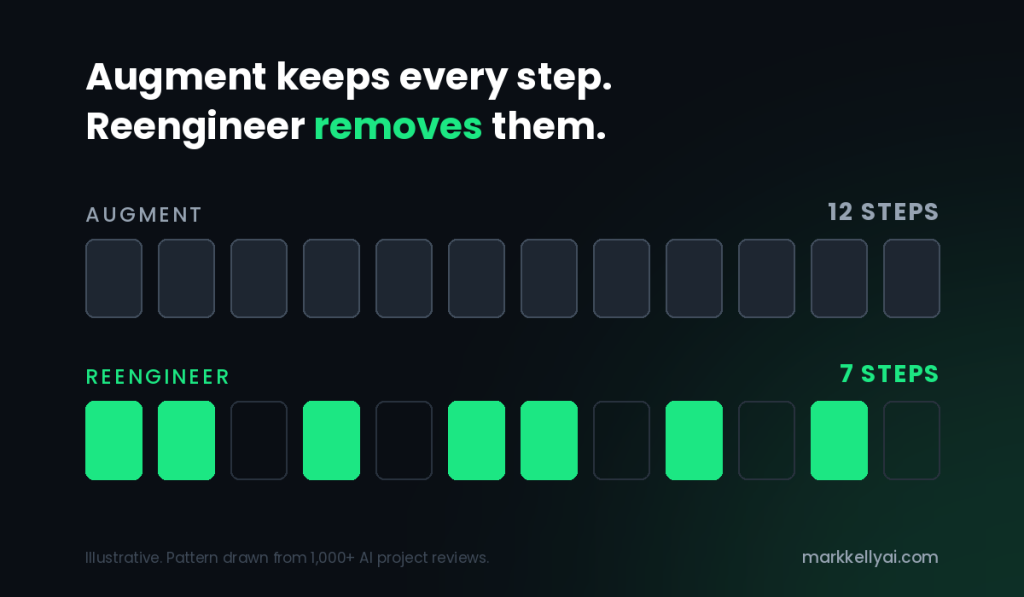
Each box is one step. Augment leaves the row untouched. Reengineer takes five of them out.
Speed is the smallest prize on the table.
The two tiers, plainly
Augment means AI helps a person do a step faster. The process stays the same. Twelve steps before, twelve steps after. Each one is quicker.
- Copilot summarising a long document
- A first draft of a proposal in ten minutes instead of two hours
- A meeting recap written for you
Reengineer means you change the process itself. Ten steps become seven. Work moves, merges, or disappears.
- A handover between two teams that no longer needs a handover
- An approval stage that existed only because nobody could check the detail fast enough
- A weekly report that gets replaced by an answer on demand
Augment saves minutes. Reengineer changes the shape of the work.
Both matter. They just pay differently.
Why almost everyone stops at Augment
Augment feels like progress because people notice it immediately. It saves time today, everyone smiles, and it goes in the board pack.
Reengineer feels like risk. It touches someone’s job, someone’s team, and someone’s budget line. So it gets postponed.
The data says the postponement is expensive.
McKinsey tested around 25 organisational attributes against real EBIT impact from generative AI. Out of all 25, the redesign of workflows had the biggest effect on whether a company saw bottom line impact. Yet only 21 percent of respondents using generative AI said their organisation had fundamentally redesigned at least some workflows.
Read that twice. The most effective lever was also the one pulled least often.
Worth noting the timing. That survey went into the field in July 2024, so the 21 percent is a snapshot from the early scramble. The direction has held since.
In the November 2025 follow up, only 39 percent of respondents attributed any level of EBIT impact to AI, and most of those said it was under 5 percent. The small group McKinsey calls AI high performers, roughly 6 percent, report redesigning workflows and pushing for transformative change rather than efficiency alone.
And here is the sentence that explains the whole problem. Eighty percent of companies set efficiency as an objective of their AI work. The ones seeing the most value set growth or innovation as additional objectives.
Efficiency is the default goal. Efficiency is also the ceiling.
That gap between money spent and work actually changed is the same gap sitting underneath the AI bubble debate. The spending is real. The redesign mostly is not.
Paving the cowpath
There is an old phrase in process work. Paving the cowpath.
Cows wander across a field and wear a crooked track into the grass. Years later someone lays tarmac on top of it. Now you have a beautifully surfaced road that still goes the wrong way, and it is far harder to move than the mud was.
That is what happens when you put AI on a process nobody has questioned. You have made a bad route faster and much more permanent.
I have reviewed over 1,000 AI projects. The strongest ones almost never made the old process quicker. They removed part of it.
Where the saved time goes
This is the question most leaders never answer, and it decides whether Augment ever turns into money.
McKinsey found that employees most often spend the time saved by automation on entirely new activities, and also on existing responsibilities that were not automated.
That is not a bad outcome. It is just an accidental one.
If you save your team six hours a week and never decide where those hours go, they get absorbed. Nobody is lying to you when they say AI is helping. The help simply never reaches the P&L.
So decide it out loud. Those six hours go to customer calls. Or to the backlog. Or to the redesign work itself. Pick one and say it.
How to find your first Reengineer candidate
You do not need a transformation programme. You need one process and a whiteboard.
- Pick a process you already augmented. Somewhere AI is genuinely helping. You have earned the right to question it.
- Write out every step. Ten to fifteen is the sweet spot. Include the waiting, the sign offs and the chasing. Those are steps too.
- Mark each step with why it exists. Not what it does. Why. You will find steps that exist only because a human could not check something quickly enough, or because two systems never talked to each other.
- Delete before you automate. Any step whose only reason is a limit that AI has removed is a candidate for deletion, not acceleration.
- Count the steps again. If the number has not fallen, you have augmented, not reengineered. That is fine. Go back to step one with a different process.
- Name one owner and one number. Steps removed, days saved, or cost per case. One person, one metric, ninety days.
Step four is where the real disagreement happens. Protect it. That argument is the work.
Augment is not a failure. It is the training ground.
None of this means Augment is a waste. It is how your organisation earns the judgement to reengineer safely.
Nobody should redesign a process they have not used AI inside. You will guess wrong about what the tools are good at.
This is the same principle behind how leaders actually learn AI, which is to practise where failure is free. Augment is that practice ground, at organisational scale. Low stakes. Quick feedback. Real understanding of what breaks.
The mistake is not starting at Augment. The mistake is finishing there.
Three things that stop Reengineer before it starts
Process is the second of the 5 P’s of AI readiness, and it is the one that exposes weakness in the others fastest.
- Frightened people. Nobody will help you delete a step if they think the step is their job. That is why AI readiness starts with your people and an honest conversation, not a process map.
- Data you cannot trust. Removing a checking step is only safe if the input is reliable. If it is not, you need to fix it at source, which is the whole argument for data readiness and going upstream.
- A supplier you cannot question. Redesigning a core process around a tool you do not control is a strategic decision, not a procurement one. Ask who can switch it off, because compliance is not control.
Reengineer sits on top of the other three. Skip them and the redesign collapses the first time something goes wrong.
The task is the unit
There is a reason this module follows the argument that AI takes tasks, not jobs.
If tasks are the unit of change, then the process is where tasks are arranged. A process is just a queue of tasks with handovers between them.
Augment improves the tasks. Reengineer rearranges the queue.
That is the whole idea in one line.
Your homework this week
One process. One page. Every step written down, with the reason it exists beside it.
Then circle the steps that exist because of a limit that no longer applies.
Do not automate anything yet. Just circle.
And there is a third tier
Augment makes a step faster. Reengineer cuts steps out. There is one more question underneath both.
Should this process exist at all?
That is Reimagine, and it is where the biggest returns and the biggest arguments live. It gets its own module.
For now, do the honest version of this one. Most organisations have never finished it.
The line to remember
If your entire AI programme is faster versions of the same twelve steps, you will spend two years proving AI works and never prove it was worth it.
Frequently asked questions
What is AI process redesign? It is changing the shape of a workflow because AI has removed a limit that the old design was built around. It is different from automation, which speeds up the steps you already have.
What is the difference between augmenting and reengineering a process? Augmenting makes an existing step faster and leaves the step count the same. Reengineering changes the process so there are fewer steps, fewer handovers, or a different order.
Why do most AI projects stop at augmentation? Because it is visible, quick and safe. Reengineering touches roles, budgets and ownership, so it gets postponed. It is also the change most strongly linked to bottom line impact.
How do I know if I have actually reengineered a process? Count the steps before and after. If the number is the same, you augmented it.
Where should I start? Start with a process where AI is already helping. You will have the understanding to question it honestly, and the team will already be comfortable with the tools.
Work with me
I run executive AI workshops where leadership teams take one real process, map it, and cut steps out of it in the room. You leave with a redesigned workflow, a named owner and a ninety day number, not a slide deck.
Sources
- McKinsey, The state of AI: How organizations are rewiring to capture value, March 2025 (survey fielded July 2024, 1,491 respondents in 101 nations): https://www.mckinsey.com/capabilities/quantumblack/our-insights/the-state-of-ai-how-organizations-are-rewiring-to-capture-value
- McKinsey, The state of AI in 2025: Agents, innovation, and transformation, November 2025: https://www.mckinsey.com/capabilities/quantumblack/our-insights/the-state-of-ai
Share This Story, Choose Your Platform!
Planning an event or leadership offsite?
Mark Kelly delivers evidence-based AI keynotes and hands-on AI leadership workshops for boards, executive teams and conferences across Ireland and Europe.